
We’ve arrived at the Vernal Equinox, the start of the new year for many people in Central Asia and beyond: Zoroastrians and many Iranians. Here in Toronto spring began with drizzling rain, not uplifting sunshine. Still it was an improvement on snow for those of us impatient for the arrival of green growth
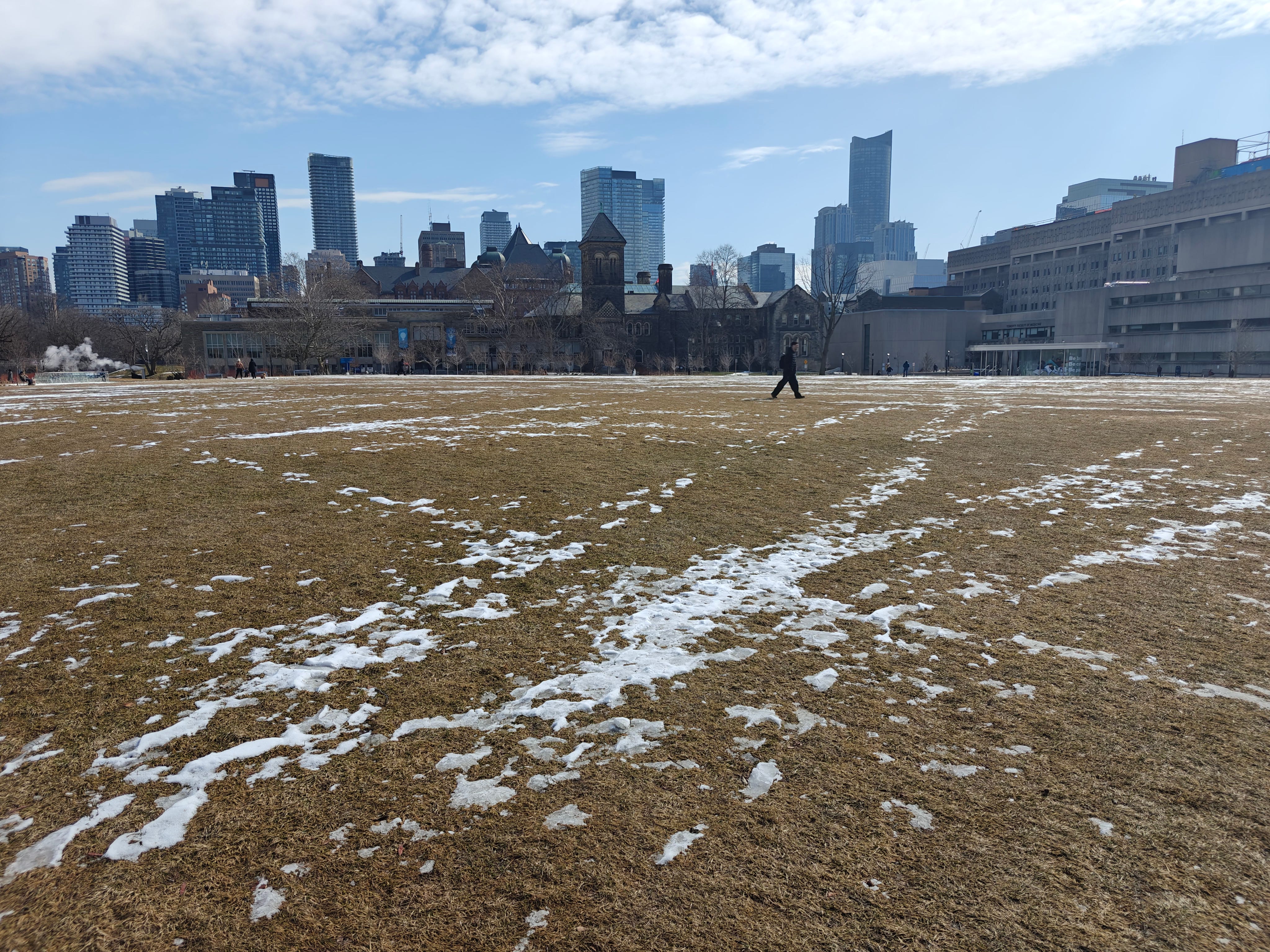
the traces of winter are slowly fading; remnants of paths across Kings College Circle at the University of Toronto

but it’s hard to find my footing right now
I somehow had assumed that I’d be feeling a little lighter once spring arrived. Instead I am weighed down almost more now by the reality of the loss of Tashi. It’s feeling heavier than ever. And beyond that, the wider world is also a place of deep grief and loss. At the start of the fourth week of the US-Israeli war against Iran, focused attention, creative energy, and any kind of optimism are all in very short supply. What a harsh way to enter the season of hope
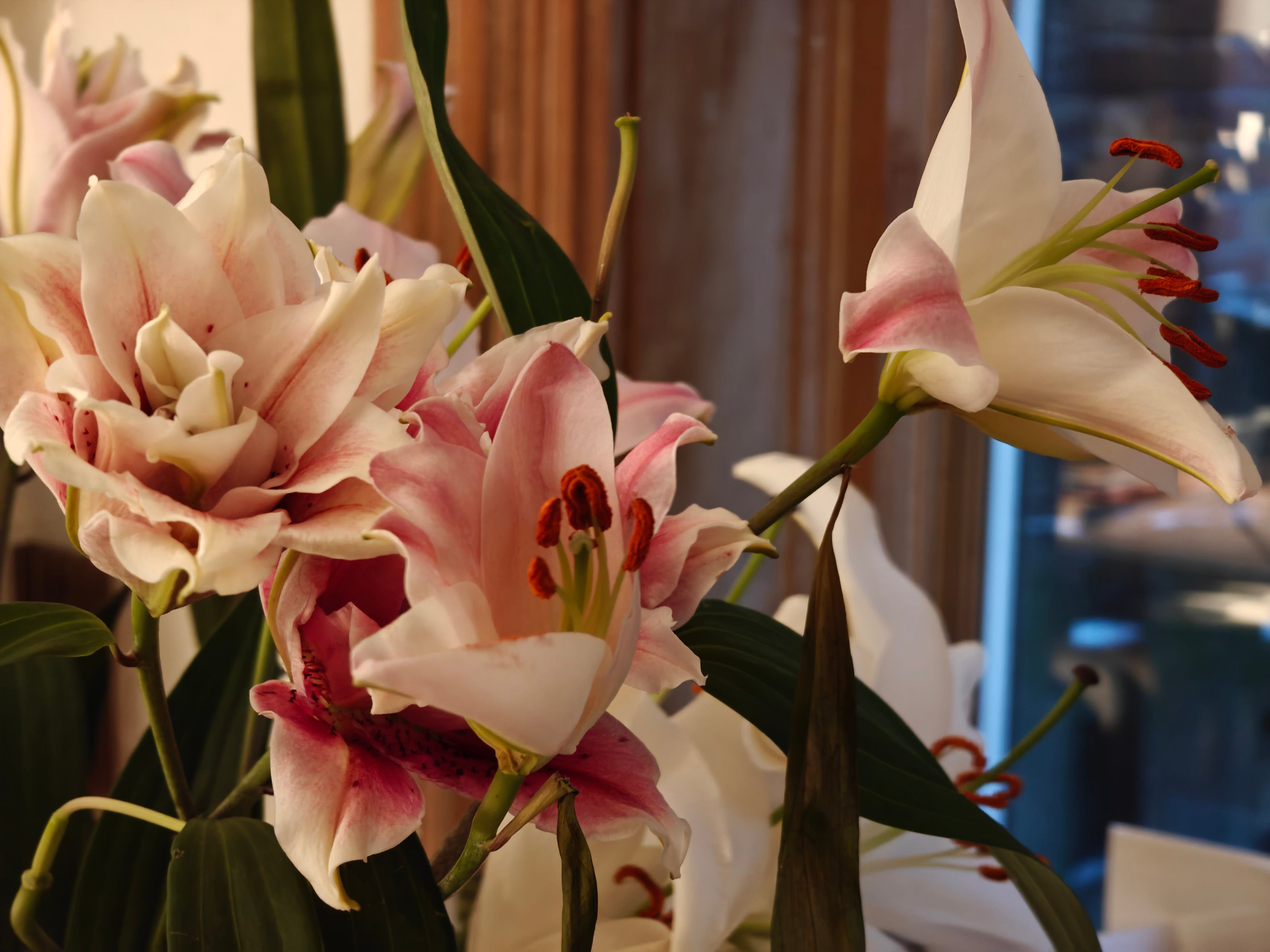
there’s still beauty; but it’s imported and ephemeral right now
The other day I went to a two-hour lecture by Professor Timothy Snyder on colonialism and empire that drew on Arendt and Fanon and others, as well as on his own wide and deep historical knowledge and understanding. He talked about imperialism as an element of character (and culture), the way it shapes the mindset of both the conquerers/rulers and the conquered/subjects. Those thoughts resonated with me afterwards: the assumption of the militarily powerful that they can shape the world as they wish, as we’re seeing with the disorganised mindless launch of this war. And then on the domestic front in the US, there’s the assumption by the senile president and his fascistic enablers that the populace, as well as the country’s institutions, can be cowed into obedience.
I’m left with these scattered thoughts: Violence seems to be seductive and addictive. It sucks people into a feeling of excitement and necessity. How do we counteract this? The steeply rising price of gas and other fuels should have a sobering effect on war-enthusiasm. Will people in the US rise up against the war? The US and Israel seem to have underestimated the capacity and will of the Iranian government to resist military coercion (whatever the cost to the Iranian people). The instigators of this war are like the schoolyard bully who has misjudged his target’s strengths and finds himself no longer in control of the situation.
Meanwhile the humans on the ground in all the countries involved, the families, the elderly, the nurses and doctors, the people of every kind who are caught literally in the crossfire, are all vulnerable. And the waves of fear and grief that must be surging across the region are unimaginable. Then there are cultural losses: libraries, churches, mosques, architectural treasures, and more, as well as catastrophic environmental damage.
The West condemned the Taliban’s destruction of the Bamian buddhas as barbaric. What do we call these current bombings?
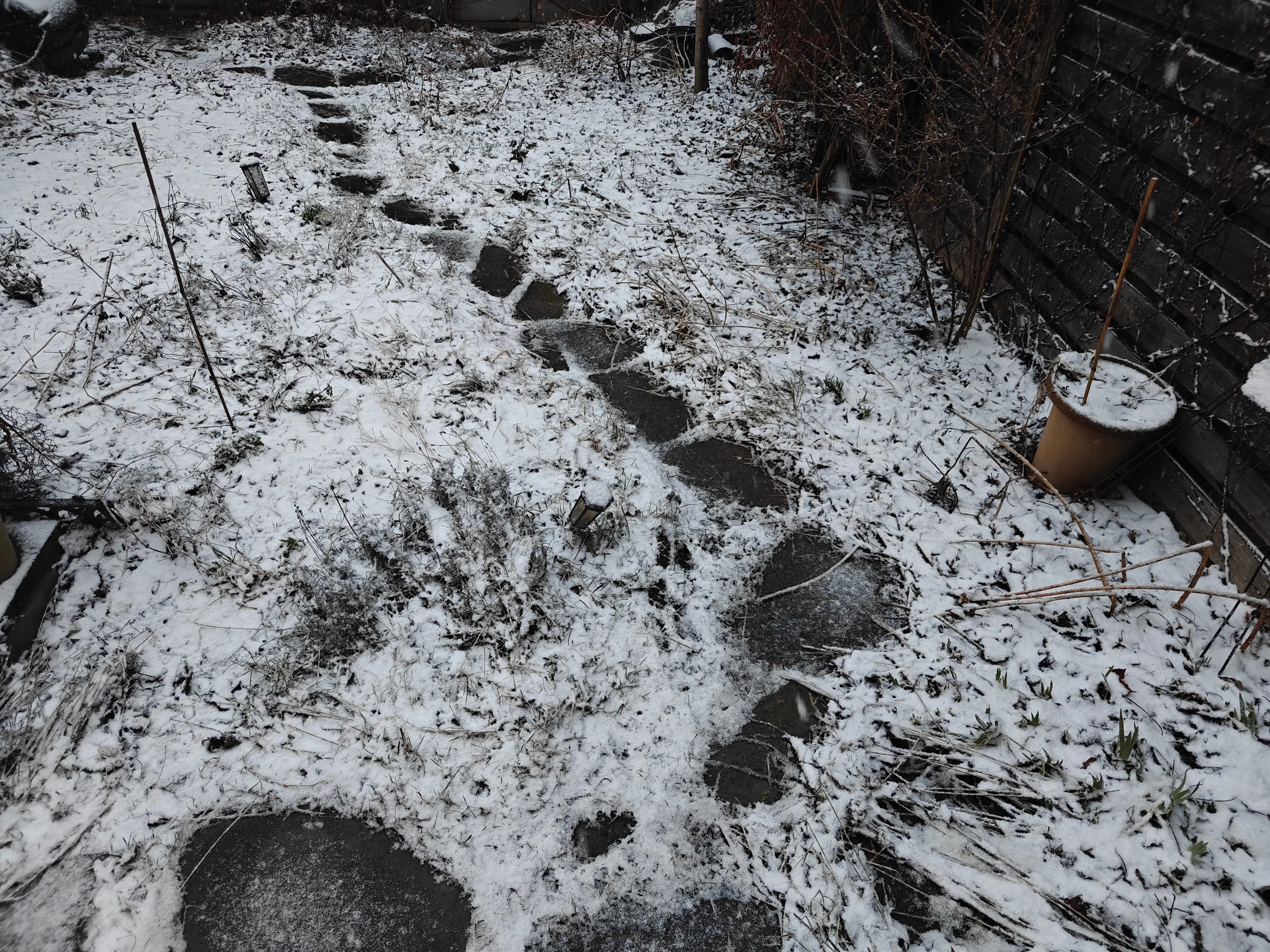
where does this all lead us?
KITCHEN EXPLORATIONS, from anchovy-garlic sauce to brown rice polo sabzi
While the news out in the world remains horrific, I’ve had an unexpectedly positive week in the kitchen.
As often happens, one happy discovery arose because one night I was stuck with no good plan for supper, and then an idea for improvising turned out to be solid gold. Here’s how it went: I had brussels sprouts and I had taken a small package of merguez out of the freezer. Merguez are (delicious) Moroccan-Algerian style spiced lamb sausages, and these came from our friends at Black Sheep Farm in Grey County. The weather had turned cold and snowy for the umpteenth time this month, so oven-roasting seemed like a good plan.
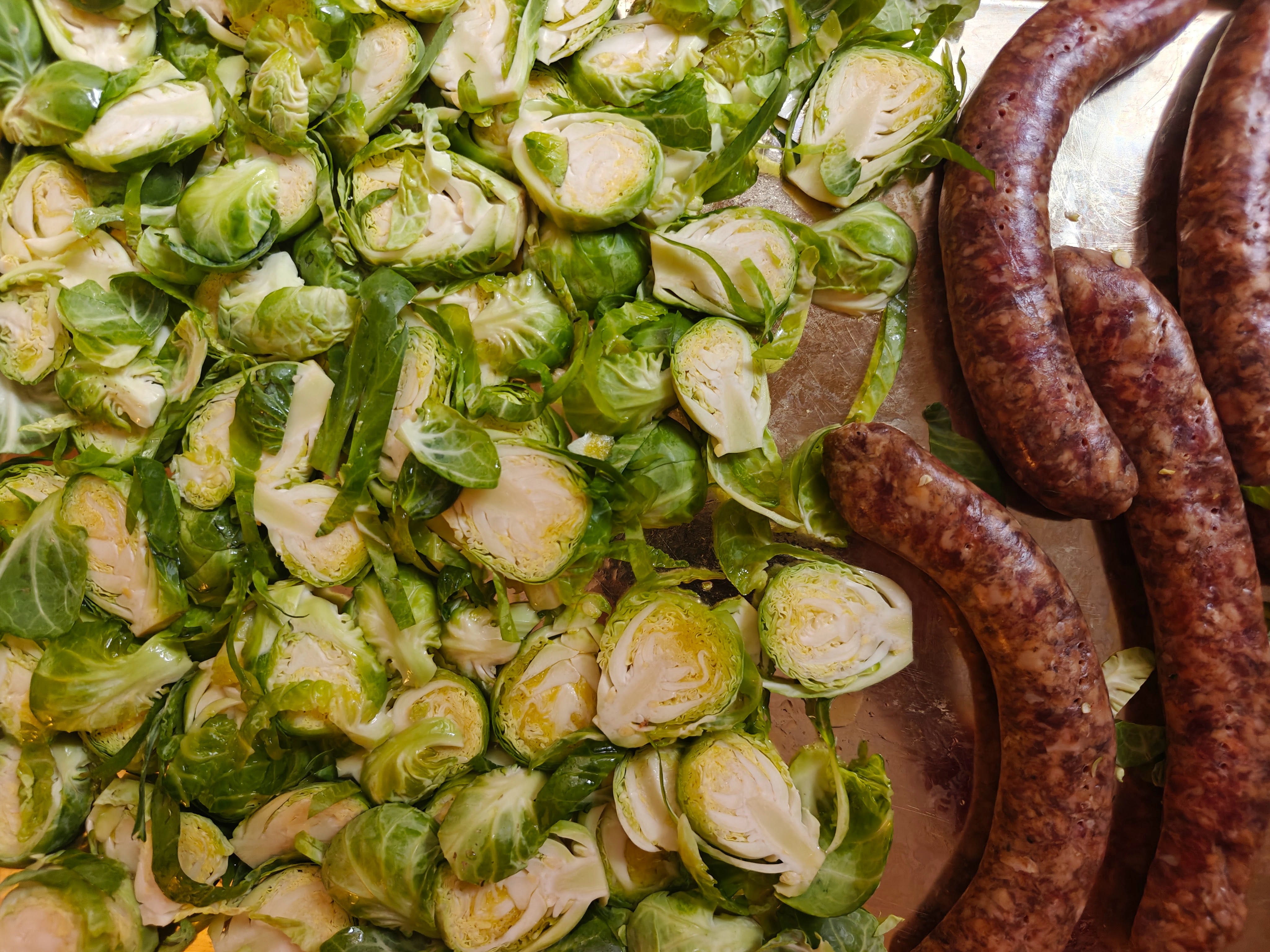
just before the pan went into the oven
I sliced each brussel sprout into five or six (they were quite large and very firm) and laid them onto a large baking sheet. The merguez fitted along one end, pricked by a fork. I drizzled some olive oil and fish sauce on the sprouts, then they went into a 400F/200C oven for about half an hour. I had imagined somehow tossing the brussels sprouts with some pasta. And maybe adding chopped merguez. But how to make a sauce?
Perhaps if I chopped some anchovy and garlic and cooked them in olive oil? I checked the index of Marcella Hazan’s The Classic Italian Cookbook, (published in 1980) under “anchovy” and there I found a simple sauce that gave me confidence and guidance. It was simply chopped anchovy (no garlic) cooked in a generous amount of olive oil, mashed until pulverised, thickened with grated parmesan and pecorino, and used to cook broccoli florets.
I chopped the garlic and anchovy, cooked them in olive oil in a large cast-iron skillet, mashing them with a spoon as they softened, then stirred in a generous amount of grated parmesan and black pepper.
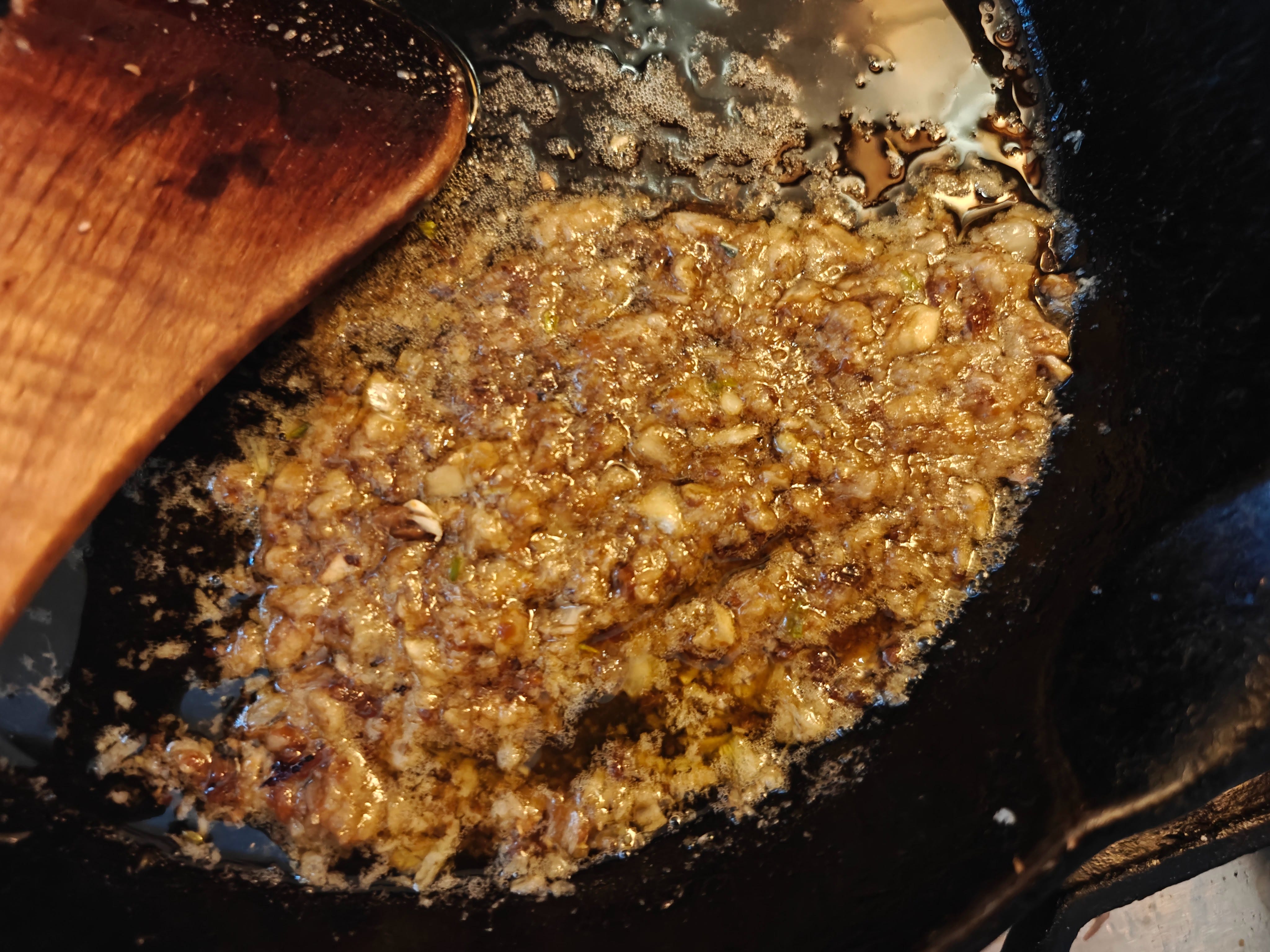
garlic and anchovy in olive oil
Finally I added the oven-roasted brussels sprouts to the sauce in the skillet. Once the pasta was cooked (whole grain mafalda; other small pastas would be equally good), the brussels-anchovy sauce made an excellent coating and flavouring. We ate the merguez separately, simply cut into short lengths.
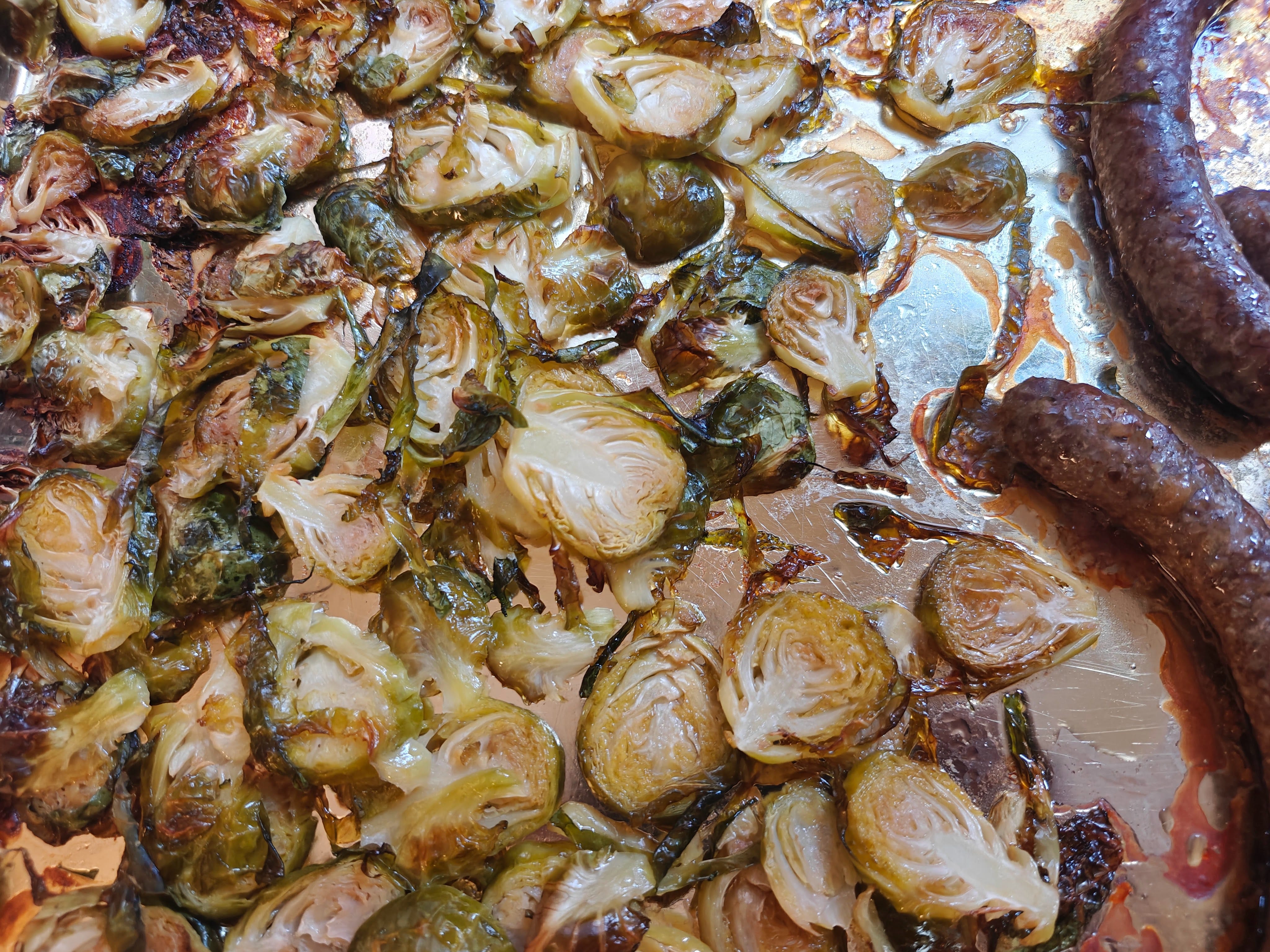
and after roasting
Brussels sprouts turn a dull green when cooked, but we know that brown food is delicious. This combo was a shining example of that truth.
Later in the week, on Thursday night, the eve of Nou-Roz, I was expecting a total of five people at dinner (we ended up being six). I thought we could make it an anticipatory and celebratory Nou-Roz-tuned meal. We had fresh lamb shoulder from Andreas of Bushbeck farm. And I had bought fresh herbs so I could make polo sabzi, a greens-loaded rice dish that is classic at Nou-Roz.
I have made polo sabzi several times with brown basmati instead of elegant white polished rice. It’s always gone well but has never been perfect. (My friend Serge Madikians, who is Armenian-Iranian and was the chef owner of the restaurant Serevan in the Hudson Valley, says that when making polo, once you put the lid on the rice to finish steaming you must send a little prayer that it will be perfect.) This time it was: fluffy, beautiful, with a great tahdig.
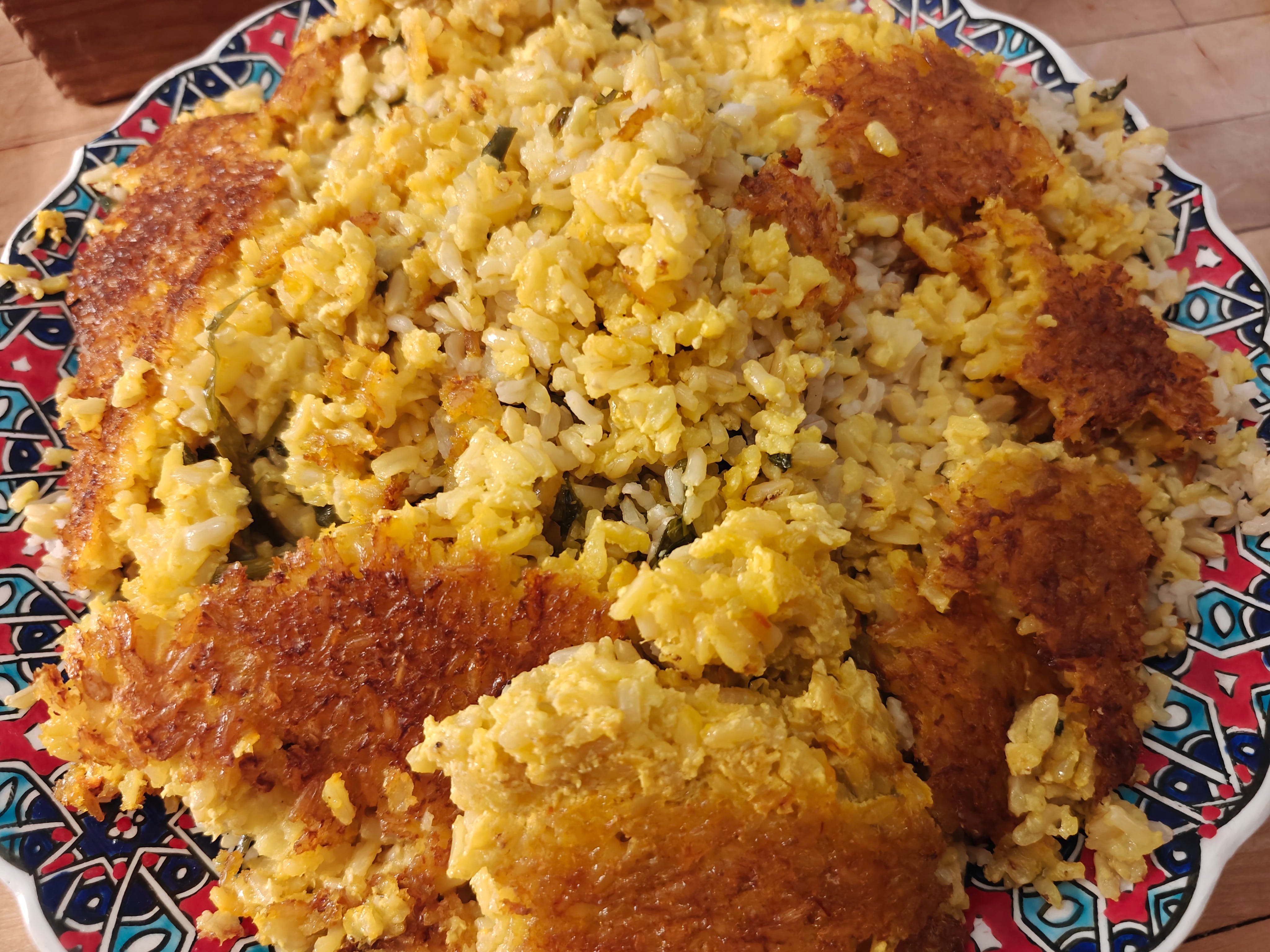
I used about 3 cups organic brown basmati from Lundberg farms and soaked it ahead in salted water for about an hour. I started cooking the rice about 2 1/2 hours before I hoped we’d be eating. The method for polo is always a first cooking of the rice in plenty of boiling salted water (as if you were cooking pasta), but only until it is slightly softened, still not cooked through. I use the same tall pot that I use for pasta. Cooking times are longer of course if you’re using brown rice. (The full instructions for classic sabzi polo using polished rice are in my Taste of Persia book and are beautifully described in Nancy Jenkins’s recent From the Kitchen Porch post.)
While the rice was boiling I washed and chopped some chives, tarragon leaves (stripped off the stems), coriander leaves and stems, and flat-leafed parsley; they made a big handful of greens. It was also the moment to make the saffron water: a generous pinch of saffron pulverised to a powder in a mortar and then stirred into about ½ cup warm water.
I prefer making a crust (tahdig) with a mix of yogurt and an egg, so in a bowl I stirred together a scant cup of plain full fat yogurt with one egg. Once the rice was softer but not cooked through (it took more than half an hour), I drained it in a sieve in the sink. I scooped about 1 1/2 cups of the drained rice into the bowl of yogurt, stirred to mix it all together, then added the saffron water.
The tall rice pot, cleaned out and empty, went back on medium-high heat. I added about 1/4 cup olive oil (or you can use ghee) and a splash of water (yes it sizzles) and then dropped the yogurt-rice mixture onto the oiled surface. It spread out naturally. I sprinkled on about a quarter of the chopped herbs. Then the remaining rice and greens went on in alternating layers, two or three of each, to make a conical mound. I used the long handle of a wooden spoon to poke six or seven holes in the mound, then dropped 7 or 8 small pats of butter onto it. As a kind of superstitious step to ensure there’s enough moisture to finish steam-cooking the brown rice (this isn’t necessary with white basmati), I always sprinkle on about ¼ cup of hot water. The last step is to wrap the lid in a cotton cloth and seal the pot closed. I raise the heat for about a minute (to help set the crust), then lower it right back down to lowest heat and leave it to cook for about an hour.
Before you remove the pot from the heat, you need a wide pot, or your sink, filled with about 2 inches of cold water. Lift the rice pot off the stove and place the bottom of the pot in the cold water (this helps encourage the bottom crust to detach, though it’s not a guarantee). After it rests there for a couple of minutes, you can turn the rice pot upside down over a platter to empty out the rice and the bottom crust. Or instead, as I do, you can spoon the rice out onto a platter. The bottom crust may stick a little: use a metal-edged spatula to ease it off the pot. Mound the rice on the platter and place the pieces of tahdig on top or around the edge.
The lamb shoulder, cut into steaks and marinated in pomegranate molasses and fish sauce, went on the charcoal grill about twenty minutes before we expected to eat, then rested before being sliced.
It’s a good idea to have a fresh salad or pickles or both with a meal like this. We had a green salad as well as oven-roasted beets that I’d chopped and dressed with a yogurt-tinged vinaigrette
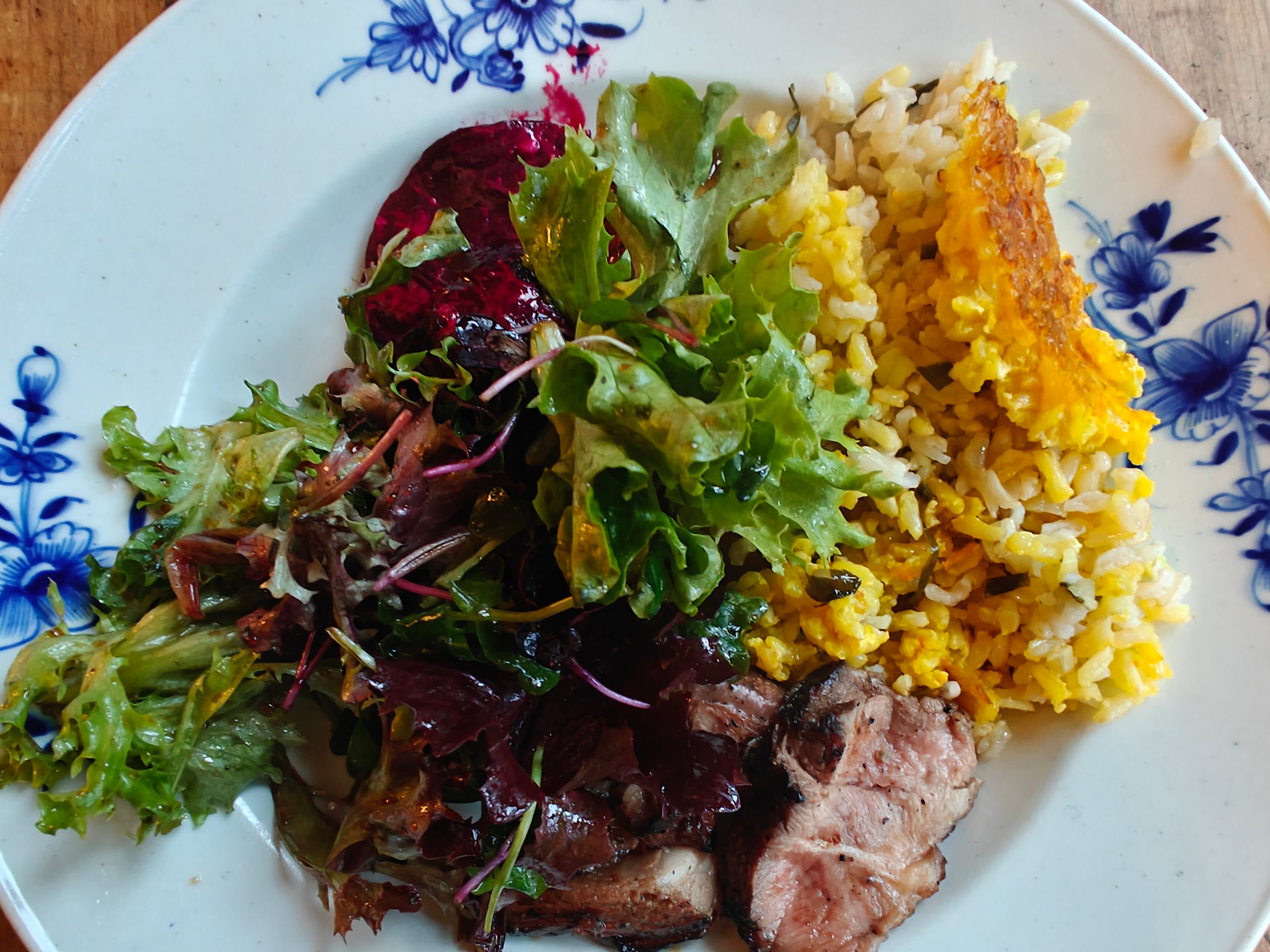
salad, polo with tahdig, beets, and grilled lamb; an assertion of spring
Gorgeous cooking, Naomi! Such a joy to read.
Reading the cooking portion of this newsletter is hunger inducing! I'm a long-time fan of your books - have cooked out of them happily for decades.
I'm so sorry about Tashi - I cannot imagine the grief of losing a child. I hope the good memories will eventually be a source of comfort in the face of your grief.
As an American deeply horrified by everything Trump does I feel so sickened by his thoughtless, evil narcissism. Professor Snyder has been all too right about this. Barbarism indeed.