
This week I landed back in Toronto on Tuesday, the first day of the lunar year of the Fire Horse. I’d traveled with hand-carry, so once I was out of the plane I could walk along the halls, ride the escalators, and navigate more corridors directly to the train into downtown. Whoosh!
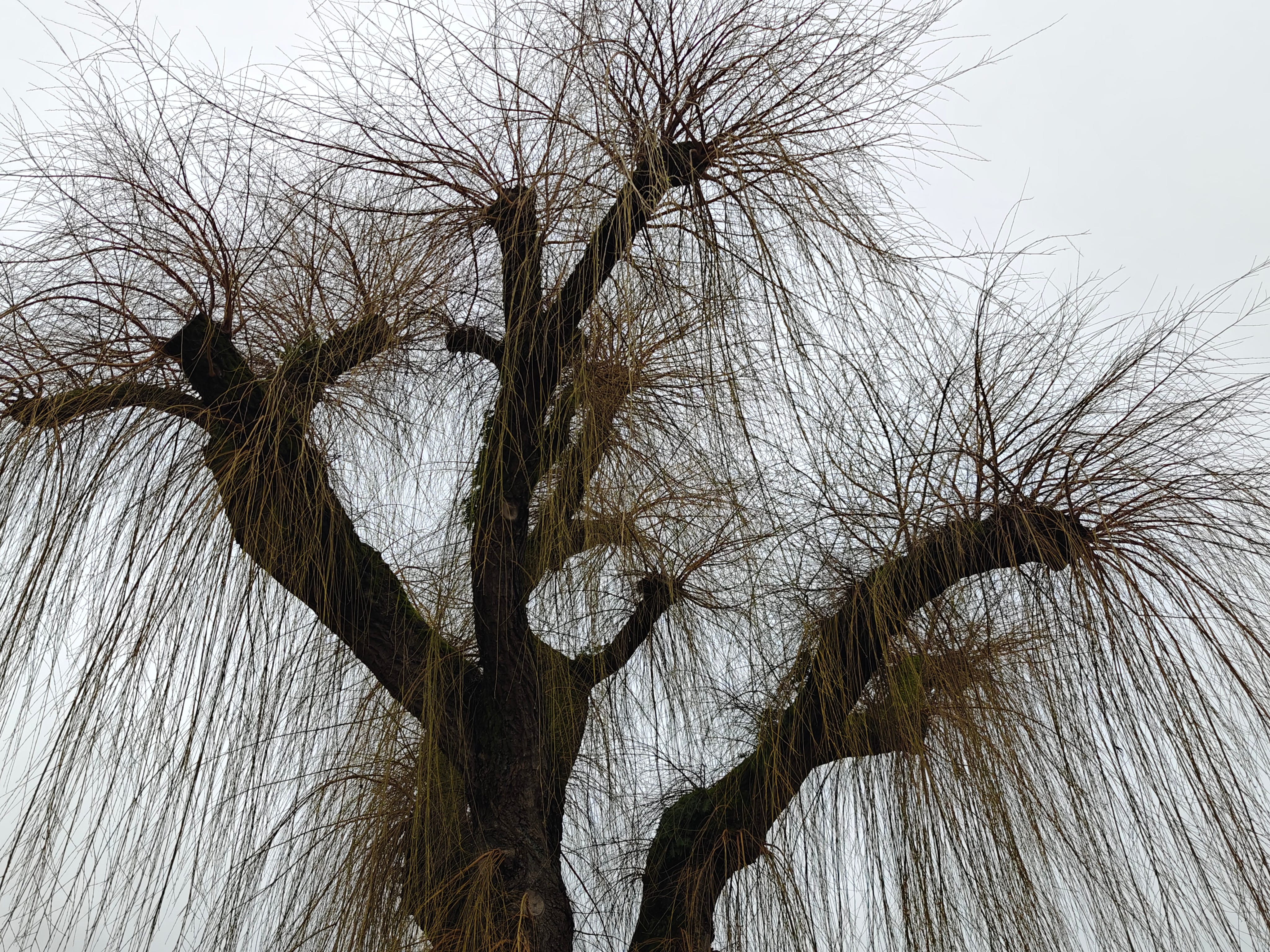
I encountered this beautiful bare willow on a walk in Vancouver
I love having hand-carry only. There’s no waiting to drop luggage or to pick it up on a carousel after landing. The trick on the plane is to be self-sufficient. I like to have a small sub-bag that I lift out of my hand-carry and have with me in my seat, with books, headphones perhaps, and maybe spare socks. I also make sure I have a shawl and a generous coat or jacket because planes are often cold and drafty. Everything else can be stashed above, leaving me maximal legroom. I always choose a window seat, because it seems to me that I get an inch or two more space there, with the possibility of stretching at least my outside leg out straight. None of this is important for short flights, but for anything over three hours (and certainly for long trans-ocean flights) it can make a huge difference.
I had wondered how I’d feel arriving back at the house after five weeks away. Tashi felt less immediately present in the house as I walked in. The space felt more neutral somehow. I no longer expected to see him around a corner. But he’d been in my head and mind’s eye a lot, because often during my trip I’d imagined telling him about something interesting or quirky that I’d seen. Then each time that impulse would fade into the fact of his absence.

another reality of arrival
Close friends have asked me whether the time away was good, or how my trip was. It didn’t feel like a trip so much as a stepping away from a complex reality into a sort of empty space. And that was a help, that break of pattern and change of place. I have good friends in Chiang Mai whose loving concern was a balm. And the break in patterns of thinking was also restorative. It prepared me for the return home, for the daily living in changed circumstances.
I’ve already this week had time and conversation with some of my close Toronto friends, whose focused attention and care have been warming and relaxing. I’m so grateful

Vancouver’s Pulpfiction Books, used book paradise, where I found a Murakami for the plane
I also had one encounter this week, during the interval at a concert, that was a reminder of the shifting burden of this grief. It was with a guy whom I rarely run into. He asked how I was and I said something neutral like “doing OK.” And then after a few sentences he said, “and how are your kids?”
I remember long ago, when I was twenty-two, being in this kind of situation. My brother Peter had died in a sailing accident in British Columbia. A few weeks later in Ottawa I ran into a friend of his named Mary who’d been out of town for a year. As we were saying a quick hello she asked where my brother was these days. I chickened out, completely. I simply said “I don’t know where he is right now.” I never saw her again, so I don’t know how or when or whether she ever learned that he’d died.
But in this case, perhaps feeling tougher and more able to deal with a response to the news of death, I said something like, “Tashi, my younger one, died in November; it was a brain tumour. It has been a brutal year.”
In that situation the first thing that usually comes out in response is an “I’m so sorry.” All expressions of sympathy, even that simple familiar phrase, take dealing with,. They’re weighty and demanding, even when tender and loving. But in this case, perhaps with the best will in the world, the person went on to engage with the news. He didn’t know Tashi personally, so it was just clumsy and awkward, wrong-footed. It’s hard to describe how cornered I felt, sort of suffocated in formalities and meaninglessness. It was a taking-away of meaning, a subtraction. I fled.
I’m not sure why I’m writing about this here, apart from a general need to unload. These break-points in life are so complex, not just for the people who are on the front line, the primary grievers, but also for those who deal with them, the outsider friends and acquaintances. There’s the natural human urge to commiserate and express sympathy. But without a ritual language beyond the plain clear “I’m so sorry” things can get awkward, painful, burdensome. As the consolers, we want to assure the grievers of our sympathy, in order to embrace them, to help them feel strengthened by our loving concern. (Of course if we’re instead doing it just to perform concern rather than genuinely feeling it, we’re really burdening the griever and being jerks.)
As a person grieving I find a simple expression of sympathy is a welcome acknowledgement of loss and pain. But when people try to build a conversation on top, it often goes astray and becomes exhausting and pointlessly painful. Close friends and family don’t say much, don’t need to. We all share a knowledge of how horrible the loss is. We can easily move together into funny stories of shared experiences to lighten our shared load. But those less intimate have nothing useful to work with. Religious language of consolation works for some people but sounds like empty platitudes to me. An insult.
I guess my takeaway advice to those wishing to express sympathy is to keep things intentional, warm, and brief. Think about the person grieving and what they might need/want, not about your own performance
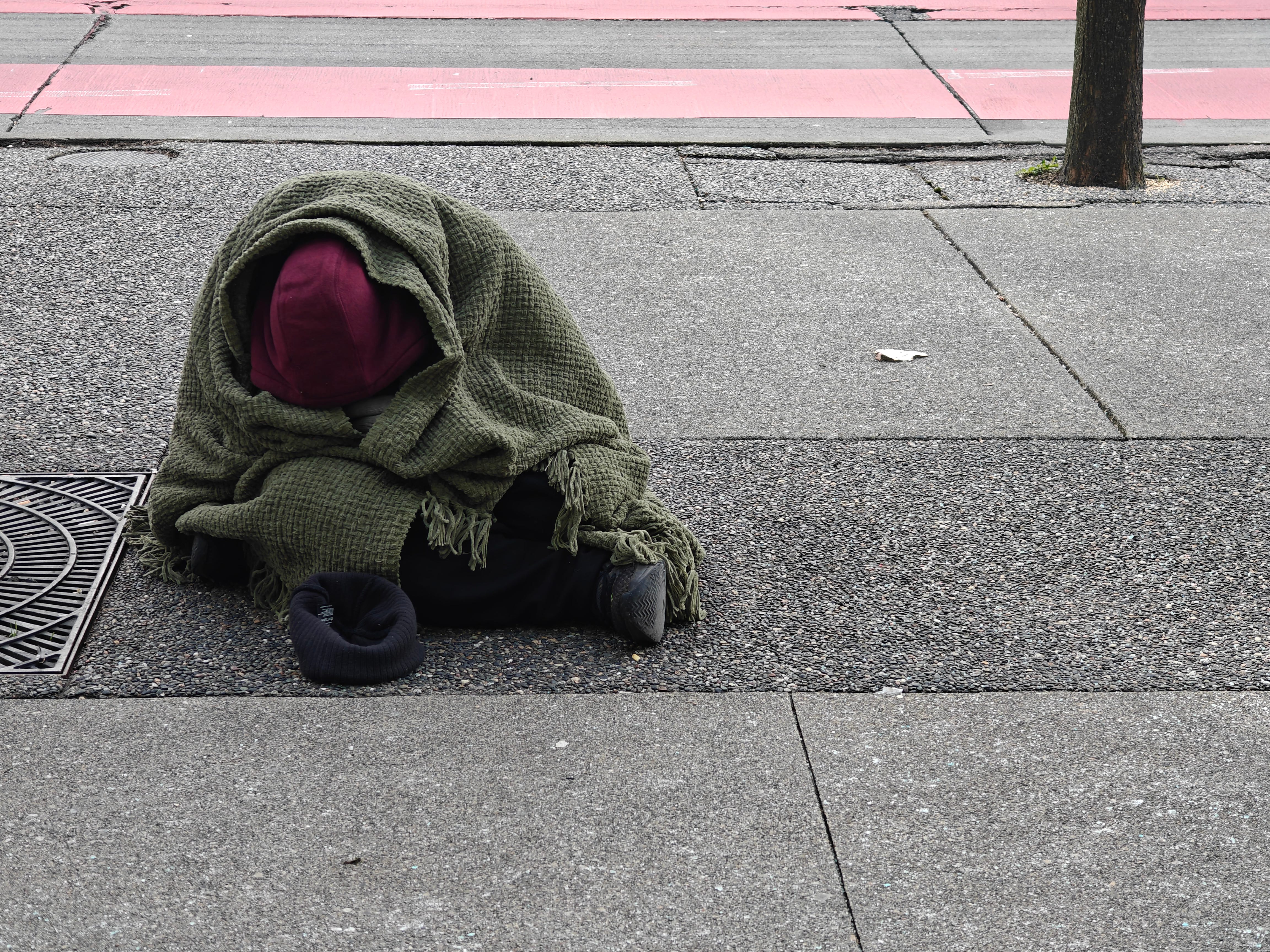
someone to grieve for right now; an unidentifiable street person on West Broadway in Vancouver
Have you had these experiences? In either role? What’s your take on this?
KITCHEN EXPLORATIONS ON RE-ENTRY, including crepes, stir-fried rice noodles, and feasting with friends
I arrived back in Toronto last Tuesday evening to a perfect return-home meal of sliced bavette, cooked dressed greens, and tender sweet potato. The house was warm and welcoming.
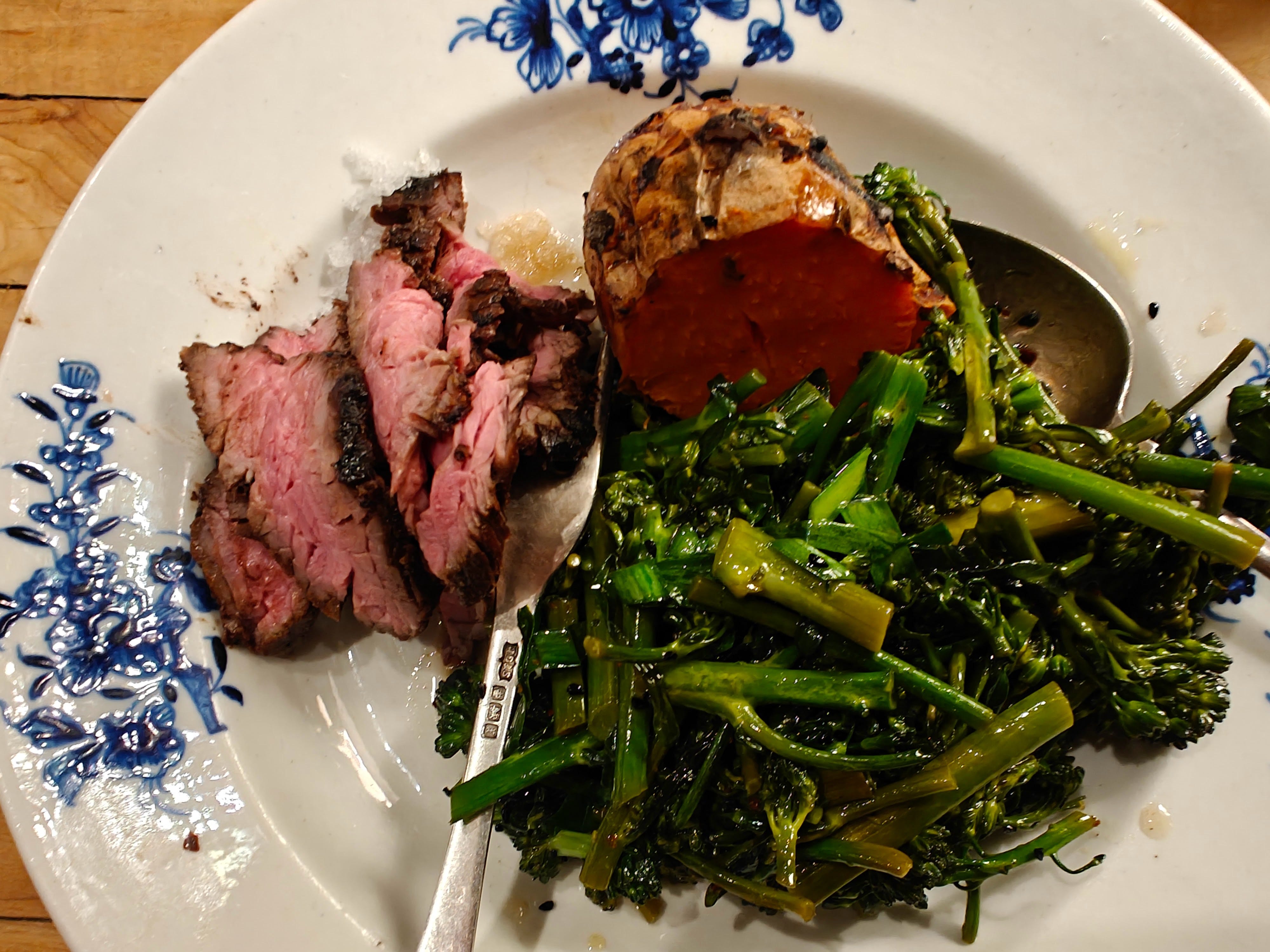
best arrival meal: slices of charcoal-grilled bavette with sweet potato and dressed greens
The next morning I found myself thinking about what to make for supper, the first time in five weeks that I’d had those thoughts. There were chicken thighs in the freezer. Simon Thibault, who did a great job of house-sitting through endless cold and snow storms, had tidied my spices and my fridge, eaten some supplies and rearranged others very helpfully. He’d also bought a cabbage, some radicchio, and some greens.
I discovered two partial packages of rice, brown basmati and forbidden rice, that needed finishing. I washed and cooked them together, with a scattering of chopped onion. It worked fine. The mixture gleamed black, especially after I added dabs of salted butter at the end of cooking.
I put wedges of cabbage drizzled with olive oil and fish sauce on a heavy baking sheet, along with the chicken thighs that I’d marinated for half an hour in a blend of pounded ginger, garlic, salt, and dried chile powder (in the absence of fresh chiles). The method is a very loose adaptation of the Kachin chicken recipe in my Burma book. The chicken and cabbage went into a 400F/200C oven for about half an hour. Once they were done, I chopped the cabbage and sliced up the chicken, then drizzled it with the lush pan juices.
Meantime, for fresh crunch and colour I’d chopped some radicchio and pea tendrils and made an improvised dressing of yogurt, olive oil, rice vinegar, and a dash of soy sauce. It needed a sprinkling of flake salt once tossed.
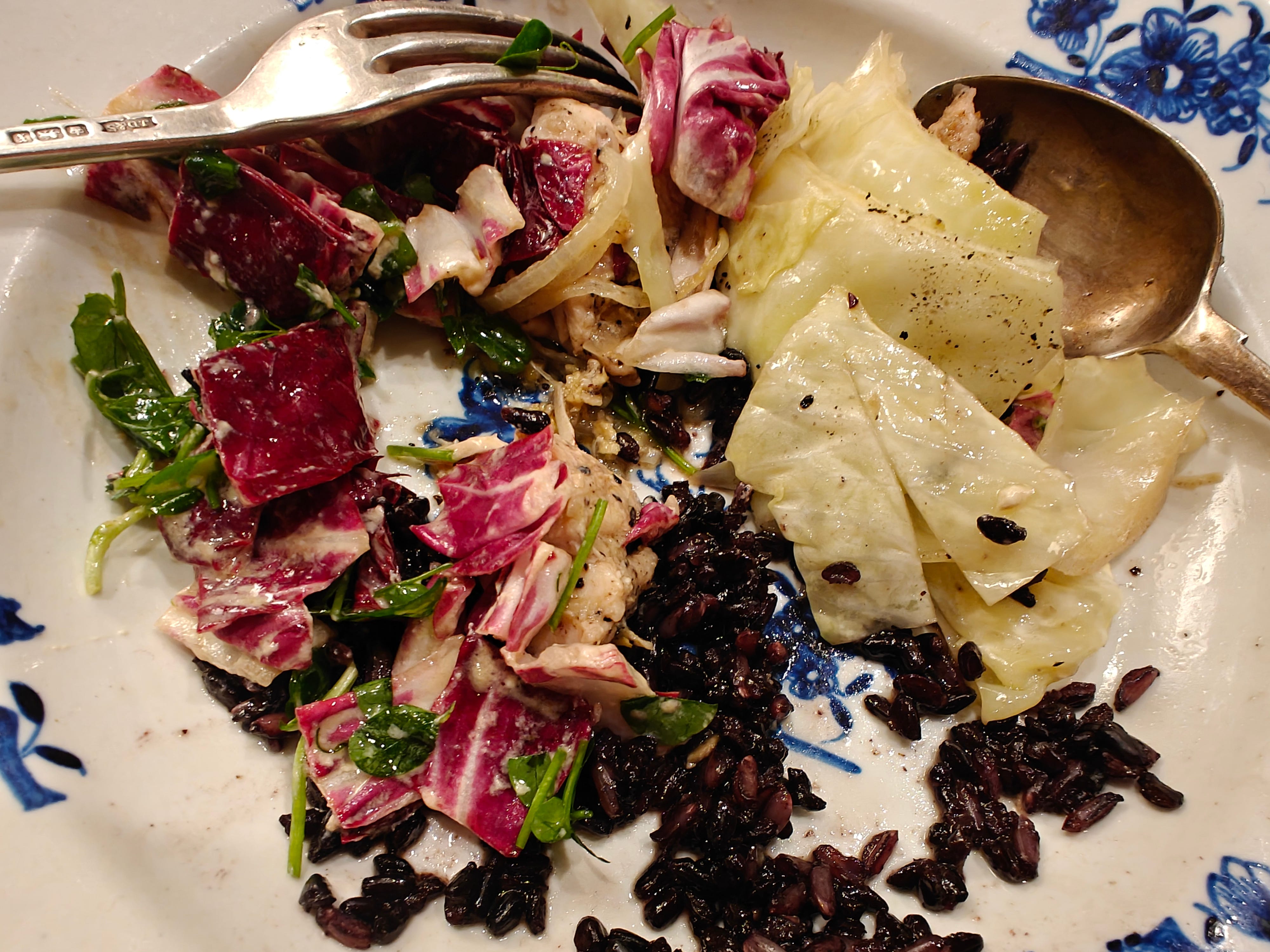
partway through supper: the radicchio and pea tendrils, the cabbage, and the black rice
On my first morning home I had had pancakes on my mind, so I’d walked out in the snow, shivering at the change of climate, to shop for eggs and milk. That evening after supper I whisked 4 large eggs with about 2 cups whole milk, a generous pinch of salt, about 2 tablespoons vanilla sugar, and enough whole grain flour to make a thin batter.
I am not a Christian but I have a long-standing cultural awareness of the major elements of the Christian calendar, including Lent, probably because of its importance in the kitchen and at the table. In most Orthodox churches, Lenten fasting means no animal products at all: no butter, milk, or eggs, as well as no meat. There may be a few days when fish is permissible (I remember 13 years ago being served fish on Palm Sunday at the table of the bishop of Javaheti in southern Georgia). Many western Christian churches do not have Lenten fasting. Those that do, as I understand it, tend to restrict merely the eating of meat from animals and birds.
These restrictions are the reason why traditionally people have celebrations and festivals just before Lent: think Carnival, and Mardi Gras (“fat Tuesday’) or Shrove Tuesday (the day you confess your sins and get shriven - cleansed of them - before the start of the 40 fasting days). Pancakes and crepes are a classic dish for Shrove Tuesday. I had missed making them this year on the day itself because it was the day I was flying home.
On Thursday morning I stirred the batter again, placed two cast-iron skillets over medium-low heat, wiped each with olive oil, and then made the crepes. Each one takes very little time. I use a ladle to scoop up a little batter, lift the skillet off the heat with my other hand, tilt the pan slightly and continuously as I pour on the batter, attempting to encourage it to flow into a round shape, then place the pan back on the heat. In about a minute the crepe is ready to be flipped over. They were fine tender pancakes in the English style, using Maris Widgeon whole-grain flour milled by Dawnthebaker. I failed to take any photos, sorry! I think I was too busy dancing the skillet dance and imagining the good eating that lay ahead.
I like stacking only two crepes on a plate, delicate approximate rounds. I squeeze on a little lemon juice, add a small drizzle of maple syrup, then loosely roll the stack up and eat it in hand. And then I stack another two and repeat… I can report that crepes delayed a day or two are just as pleasing as those eaten on the official day.
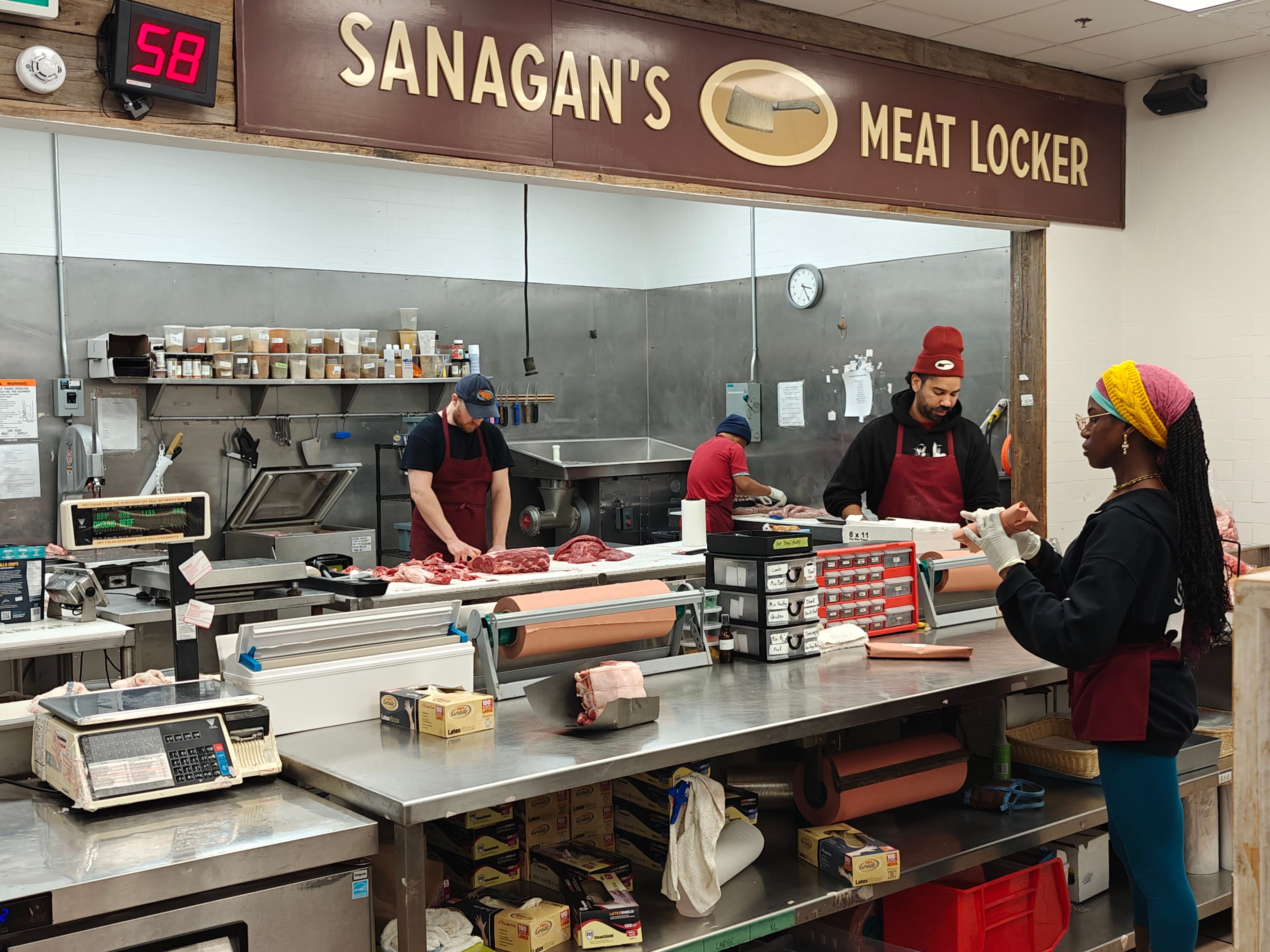
the open butcher shop scene at Sanagan’s
After my crepe breakfast, I headed to Kensington Market because a good friend was coming for supper that evening. I had some vague ideas. And when I found there were fresh rice noodles available at the tofu shop/factory, the meal took shape in my head. I bought two pounds of noodles and then stopped for a bunch of coriander and a few other veg at Kensington fruit Market. At Sanagan’s, my local butcher, I bought a scant pound of hanger steak.
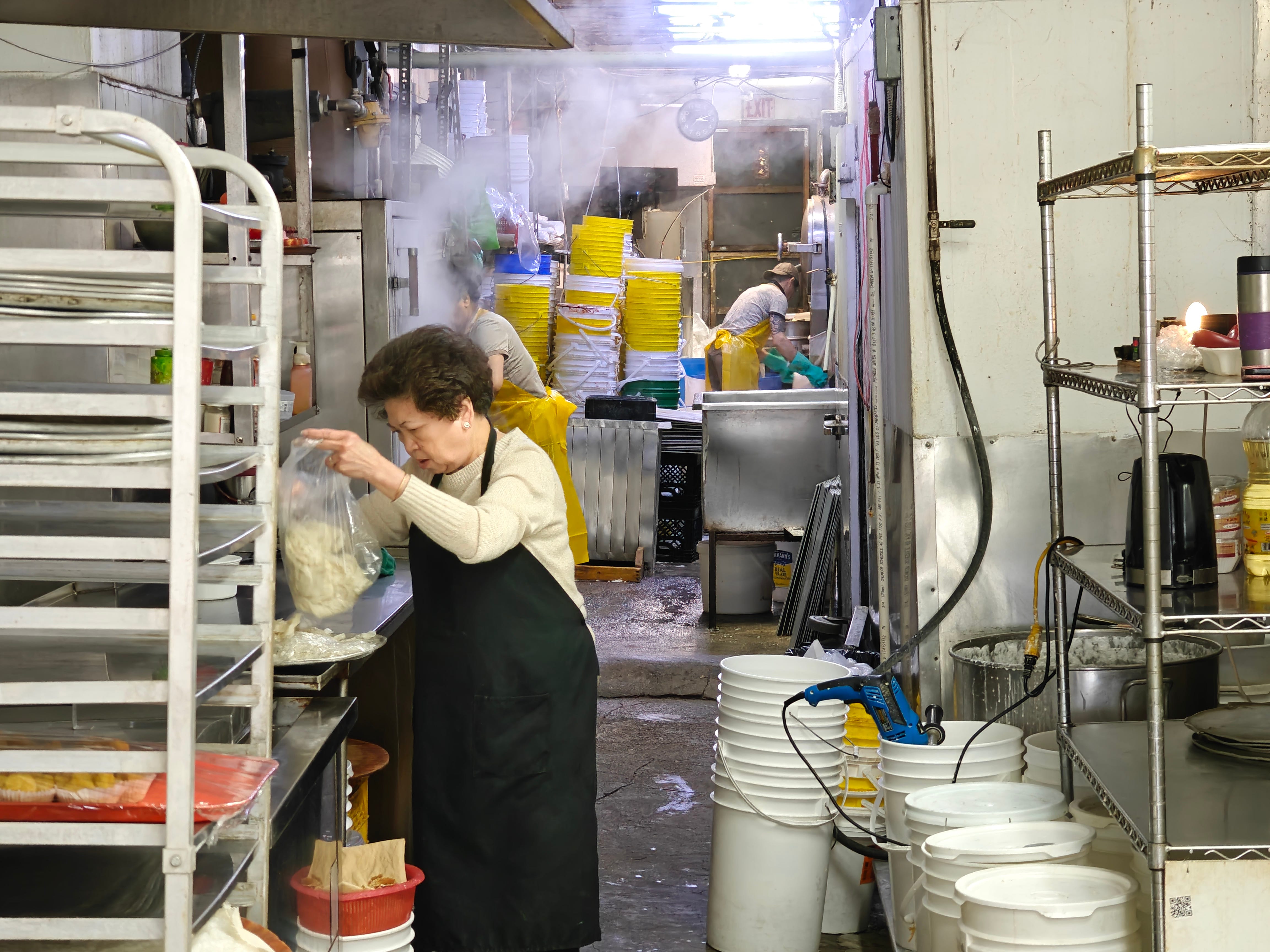
weighing out the rice noodles at the tofu shop
I ended up cooking the whole meal in the wok, starting with the hanger steak, sliced, rubbed with a little shio koji, then added to the wok with chopped chives after the chopped ginger, bird chile, garlic, shallots, had softened. I stir-fried the meat with the addition of a little water at the last moment, then turned it out into a bowl, rinsed the wok into the meat. The wok went back on the heat to cook chopped bok choy, pea tendrils, and spinach with a little garlic. Finally came the turn of the rice noodles, a tender tangle, which went into the hot oil in the wok with some pea tendrils for a few minutes of stir-frying to soften to full tenderness.
I put the noodles and the cooked greens in one large bowl and tossed them together. The meat and gravy went out separately. I made a small bowl of vinegar lightly sweetened vinegar to use as a condiment. With the help of a couple of extra people who dropped by, the whole lot was eaten; no leftovers.
And finally, last night, Saturday night, we had supper for seven, with chicken and potatoes from Footsteps Farm (at Wychwood Market) oven-roasted (the chicken smeared with shio koji and suffed with a lemon). Alongside there was a radicchio salad with kefir dressing made by Dawnthebaker, a chopped salad brought by another friend, and some dal I’d made (urad and masur together, tempered with minced onion and ginger, powdered red chile, turmeric powder, and freshly toasted and ground cumin and coriander, and topped with chopped coriander leaves).
It was a lovely feast of conversation and flavours. It gave me a real feeling of arrival, and the start of a retrieval of equilibrium

a reminder that flowers will return: morning glory blooms at Free Bird Cafe in Chiang Mai
i’m totally with you on keeping it simple and warm. anything beyond that can feel invasive or extractive on a bad day. i had a grief group recommend us to ask each other “how are you doing today” to limit the intensity of the scope and practice day by day, so i try to bring that in too
Thank Naomi for your raw honesty on the journey of grevience. And for reminder that a simple check in can be sufficient.
Always love hearing about the meals prepared and your gatherings. Sharing meals is so beautiful.