
Here we are, the huge full moon just past, the trees starting to shed their leaves and allow us larger views of the sky. We need that increased access to the blue above as the sun tracks lower and the days shorten. Each year it happens, and each year these changes feel momentous. Our bodies respond by tightening a little, bracing for the dark and chill of winter.
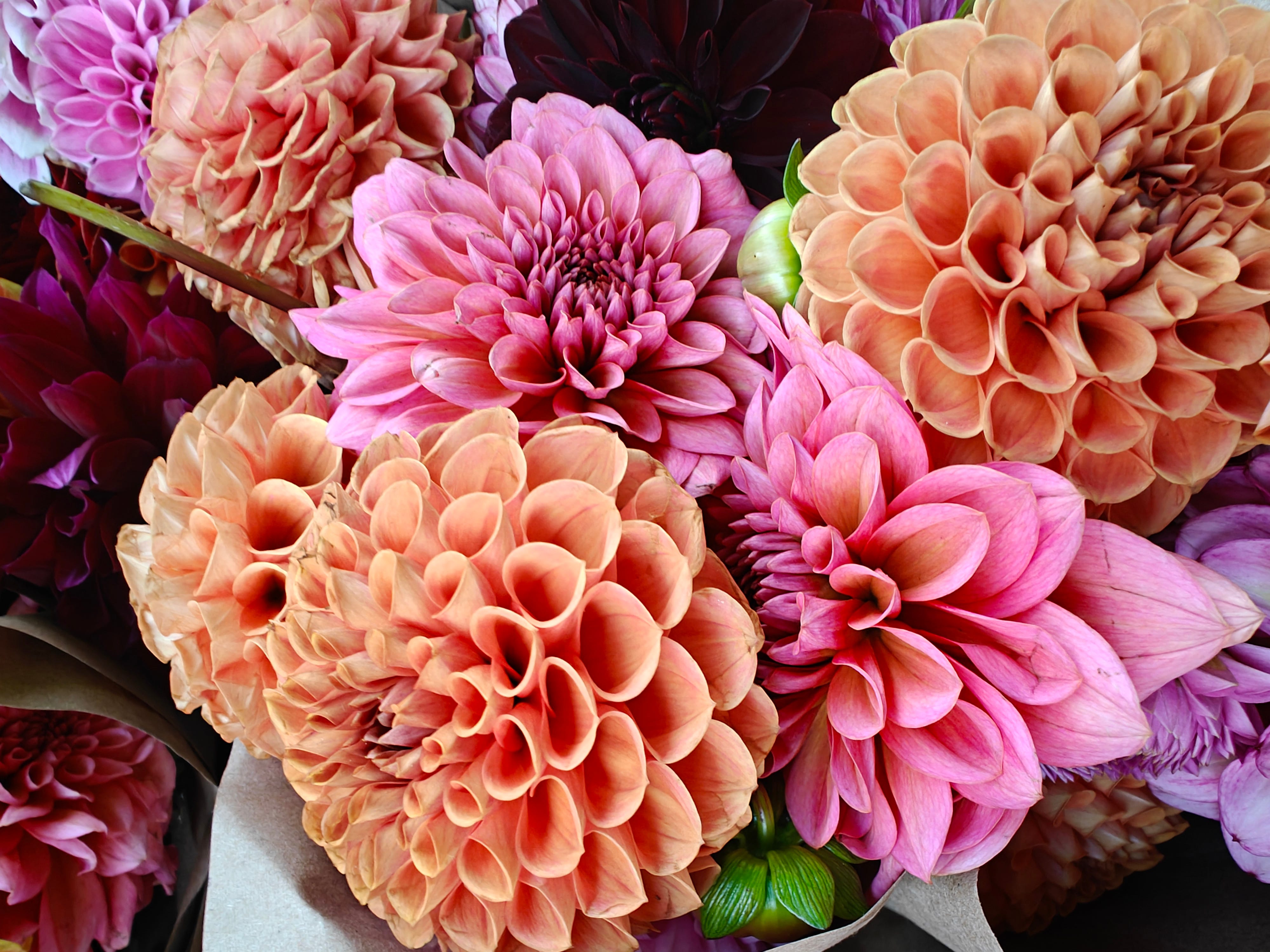
miraculous complex forms, the dahlias that are now in season at farmers markets and in some neighbourhood gardens; these were at Wychwood Market last weekend
As we retreat indoors in this season, coping with stress and anxiety can be more challenging. How do you cope?
For years I have taken refuge in simple stories. I turn to who-dunnits and similar reading when my thoughts start circling and fluttering. They’re a place to park my head.
In the last few years I’ve grown into another option: sitting down and drawing whatever is in front of me, say a coffee cup on a table in a café, or people sitting at a nearby table, or the leaves on the elderberry bush in the garden, or even my other hand. It takes me to a calm focused place. I began by simply drawing with pencil or with a fine pen. Recently I’ve started to use watercolour for sketching, and also for adding colour to pen drawings.
This spring my friend Cassandra gave me a small metal Altoids box that she’d converted into a portable palette by making a grid in it of tiny compartments, each filled with s small blob of watercolour. You can buy similar kits online. The other useful tool is a brush with a water cartridge so I can work anywhere; no need for a cup of water. Together they make a portable pleasure set.
Writer Elisabeth Luard, a brilliant botanical artist and watercolourist whose enchanting work is here on Substack, carries a similar toolkit with her everywhere, along with a small sketchbook. Wherever she is she can deftly and quickly sketch/paint a scene – creating a much more lively and engaging impression than a camera can give - without drawing attention to herself. I’ve seen her do it in crowded public spaces, from art galleries to the dining hall at the Oxford Food Symposium.
The important thing for me, as a beginner at this, is to just do it. To not worry. There’s joy and lightness in focusing on the doing, in staying in the moment. It’s not about perfection. I prefer using a pen rather than a pencil for drawing, for then there’s no temptation to erase and tidy. It’s not possible. I’m forced to work with what I have done and just keep at it. And then maybe I do a few more sketches of the same thing, perhaps using watercolour to sketch it, or simply working again with ink. (Later I can look at what I’ve done and wonder how I might try things differently next time.)
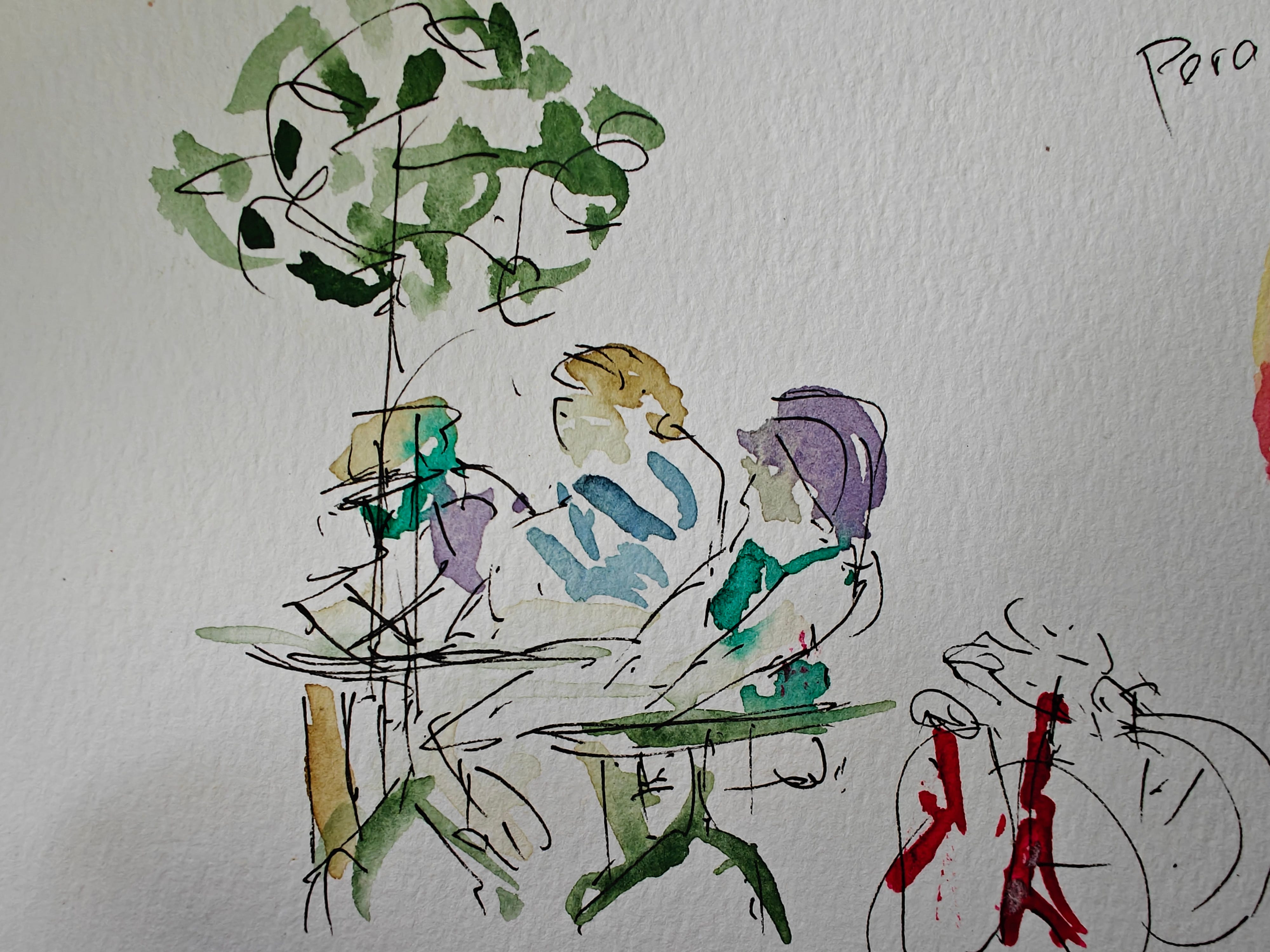
there’s joy and lightness in just doing: a quick sketch, with dashes of watercolour, while I was out at cafe Pera in Kensington Market last month
I realise that I bring the same approach to my home cooking. Perhaps it comes from not having a perfectionist’s nature. I would rather be open to the possibilities than striving for a fixed (pre-imagined) ideal. When a dish or a sketch works well, it’s a pleasure. But that doesn’t make me want to reproduce it exactly next time. I’d rather start afresh with something else.
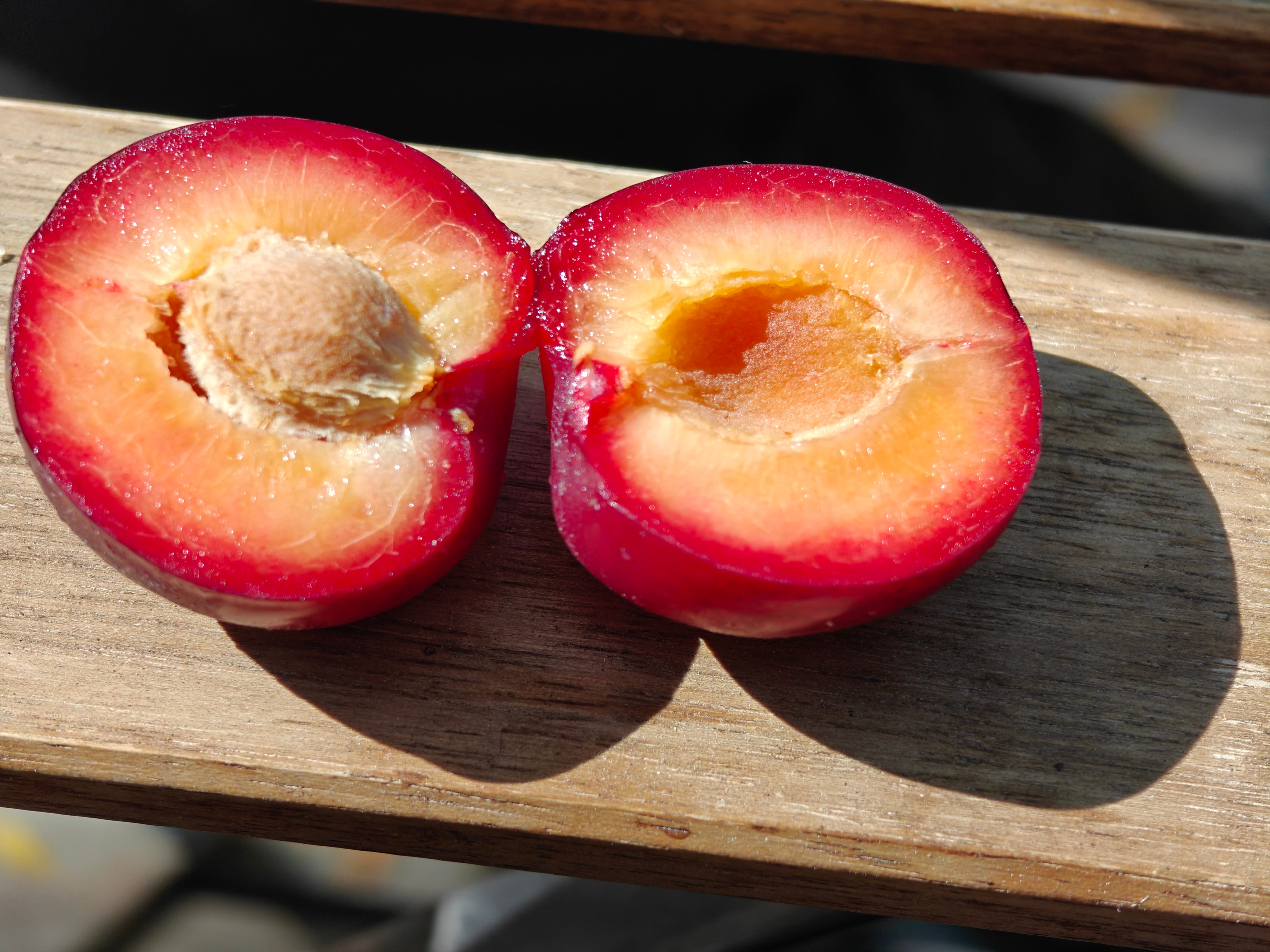
a variety of plum that’s new to me, called blood plum by some. Not a great eating fruit but it makes beautiful jam.
THOUGHTS ABOUT PLANT-FORWARD EATING, PLUS A RECIPE
The other day I found myself yearning for eggplant cooked with tomato. I could taste the flavour of what I longed for. I looked through “aubergine” in Jane Grigson’s Vegetables cookbook, a valuable classic. All her eggplant and tomato dishes were too complicated for what I sought, but the basic proportions in her recipe for boumiano, a provencal dish, were a useful guide.
I started with equal weights of chopped Turkish eggplant and ripe local tomatoes slow-cooked in olive oil flavoured with plenty of chopped garlic and mild spices. The eggplant softened in the juices of the tomato, until the textures were tender and melting. Then I added a generous number of anchovy fillets that I’d pounded to a paste. (The full recipe is below.)
The more-ish deliciousness of this simple combo was a reminder of the excellent keynote talk that was given at the Oxford Food Symposium this summer by Professor Ole G. Mouritsen. His view is that the biggest obstacle to getting people to shift to a more plant-forward diet is that most plant foods, and the dishes made with them, lack umami. A successful plant-forward cuisine needs to figure out ways of increasing the umami in plant-based dishes. This is not about promoting pure vegetarianism, in fact quite the opposite.
In Professor Mouritsen’s view we need ingredients from the animal world to help us embrace plant-based eating. He pointed out that with the addition of fish sauce or seaweed soaked in soy sauce, or any one of a number of other umami-giving ingredients, plant- heavy dishes can become deeply satisfying. And that’s what’s needed to encourage acceptance.
My eggplant-tomato simmer was a beautiful demonstration of the power of umami-laden ingredients, in this case anchovies, to lift vegetable dishes to another level
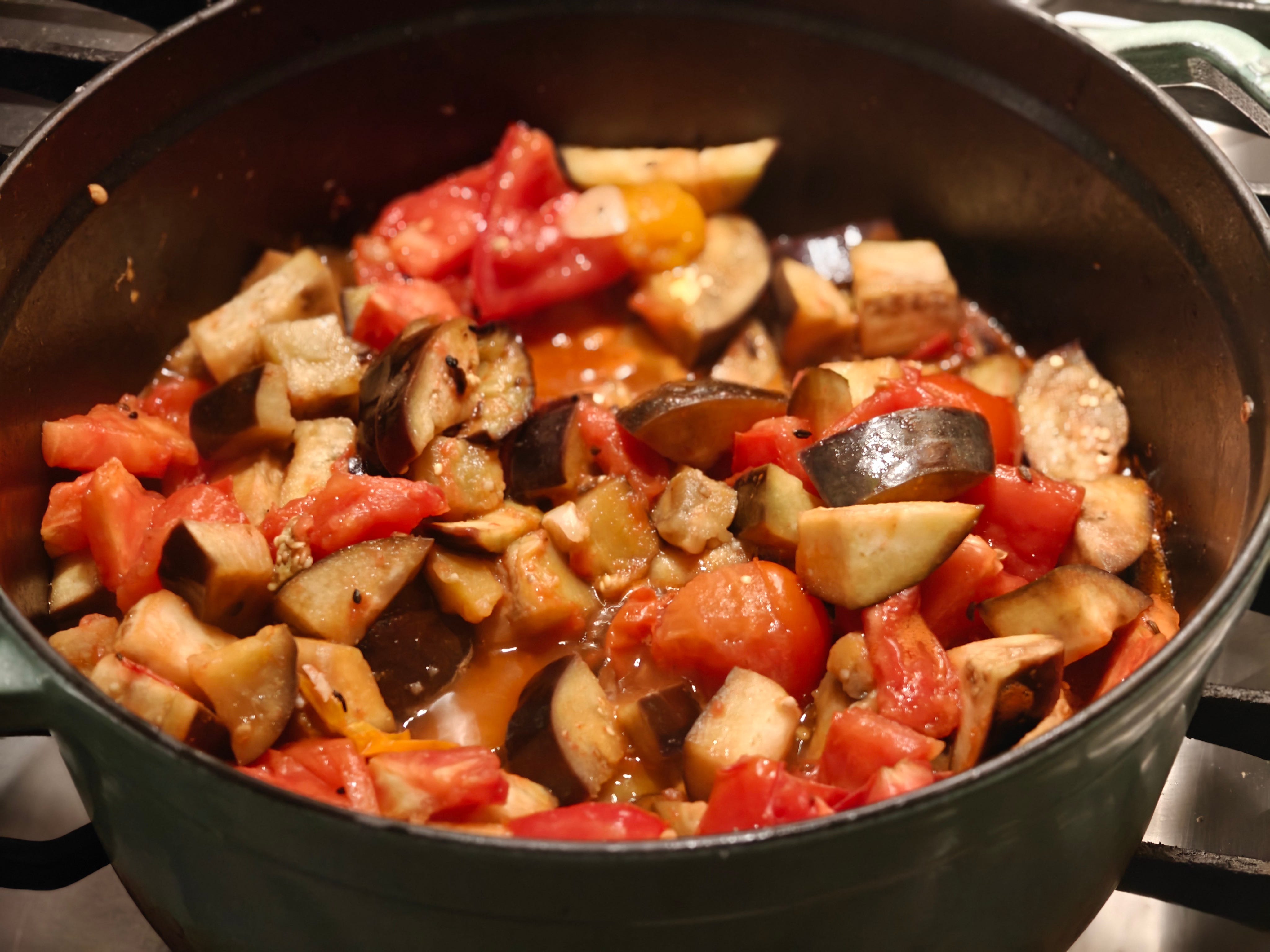
My most recent version is a doubled recipe. This is what it looked like after only five minutes of cooking. The eggplant and tomato are chopped a bit coarsely, because I was in a rush. I recommend smaller cubes, as set out in the recipes. They do shrink and soften in cooking, as you can see from the photo below the recipe.
RECIPE: SIMMERED EGGPLANT & TOMATO
I make this in a heavy pot with a lid, so there’s no fear of things sticking or cooking unevenly. This winter I’ll try making it with tinned tomatoes; it won’t have exactly the same flavor but should still be delicious.
Serve this as a side for 4 to 6, or as a main for two over rice. The version I’ve made this week is a doubled recipe, to serve as a side for a Thanksgiving meal for 10 this weekend.
About 1 pound Turkish or other Mediterranean eggplant, chopped into 1 cm/1/2 inch or smaller chunks
Salt
About 1 pound fresh tomatoes, chopped into 1 cm/1/2 inch or smaller chunks
About 3 tablespoons olive oil
1 teaspoon fennel seed
A generous pinch of nigella seed (optional)
5 or 6 cloves of garlic, peeled and chopped
8 to 10 anchovy fillets (stored in oil)
Chopped basil or flat-leaf parsley (optional)
Cut off the eggplant stems and chop the rest into roughly 1 cm/1/2 inch cubes. Set in a colander over a bowl, sprinkle on about 1 teaspoon salt, and toss to distribute the salt. Set aside for 15 minutes or so.
Meantime chop the tomato in similar sized cubes
Place a heavy pot over medium heat. Add the olive oil. Toss in the fennel and nigella seeds, and then the garlic. Cook for several minutes, until garlic is starting to soften. Add the eggplant and the tomato and turn the mass to blend it all together. Once it starts bubbling, let it cook at a medium boil for a few minutes, then lower the heat to maintain a low boil, half cover, and cook for about an hour. Check it occasionally to make sure it’s not sticking, and give it a stir.
Mash the anchovies in a mortar or chop them finely. Add them to the pot and stir well to blend them in. Continue to cook at a simmer for another fifteen minutes.
Taste for salt and adjust if necessary, using salt or fish sauce.
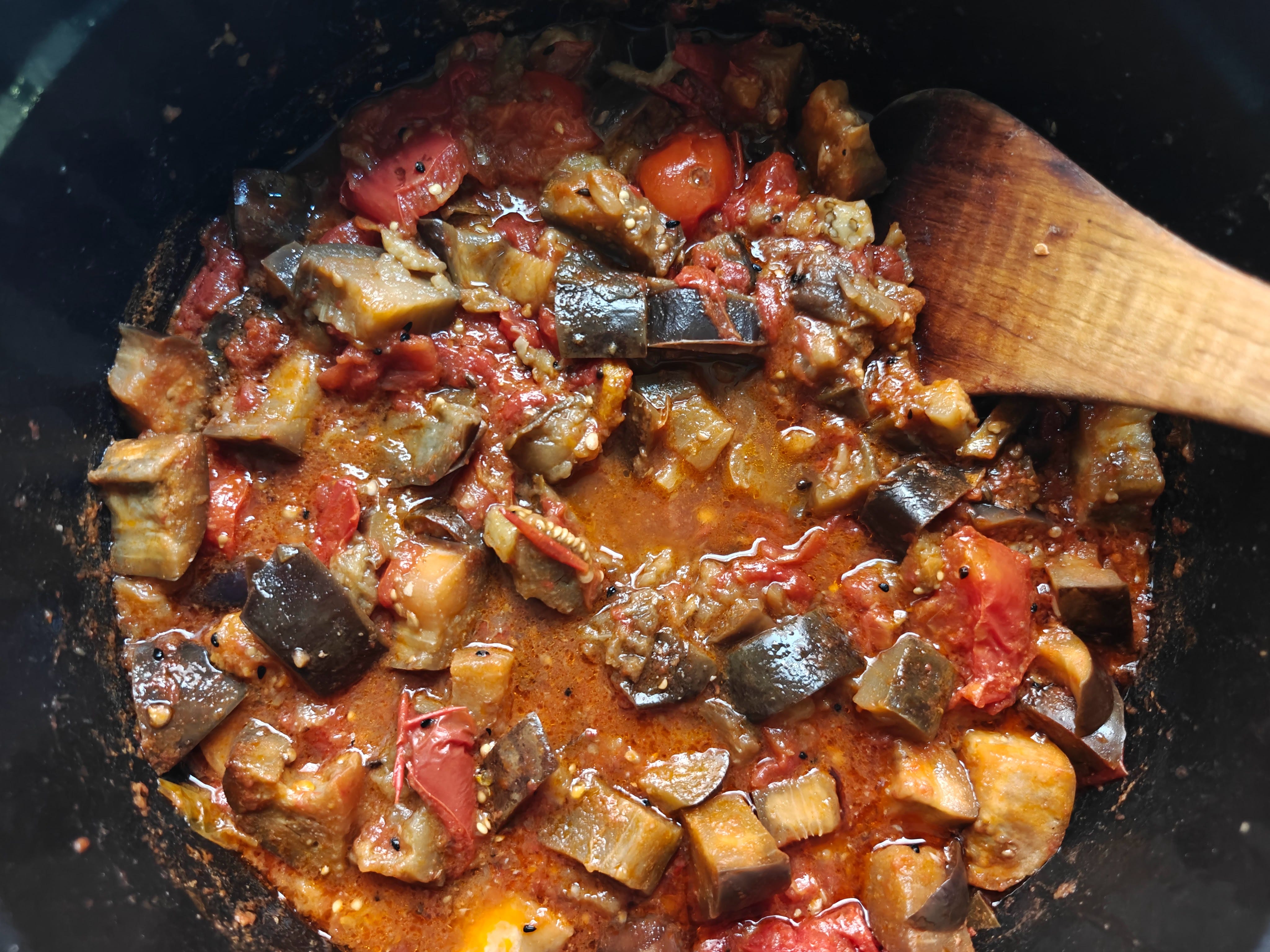
fully cooked and ready to be reheated, or instead served at room temperature
Set the pot aside, covered, until you are ready to serve it. Or you can reheat before serving. Top individual servings with chopped herbs if you wish.
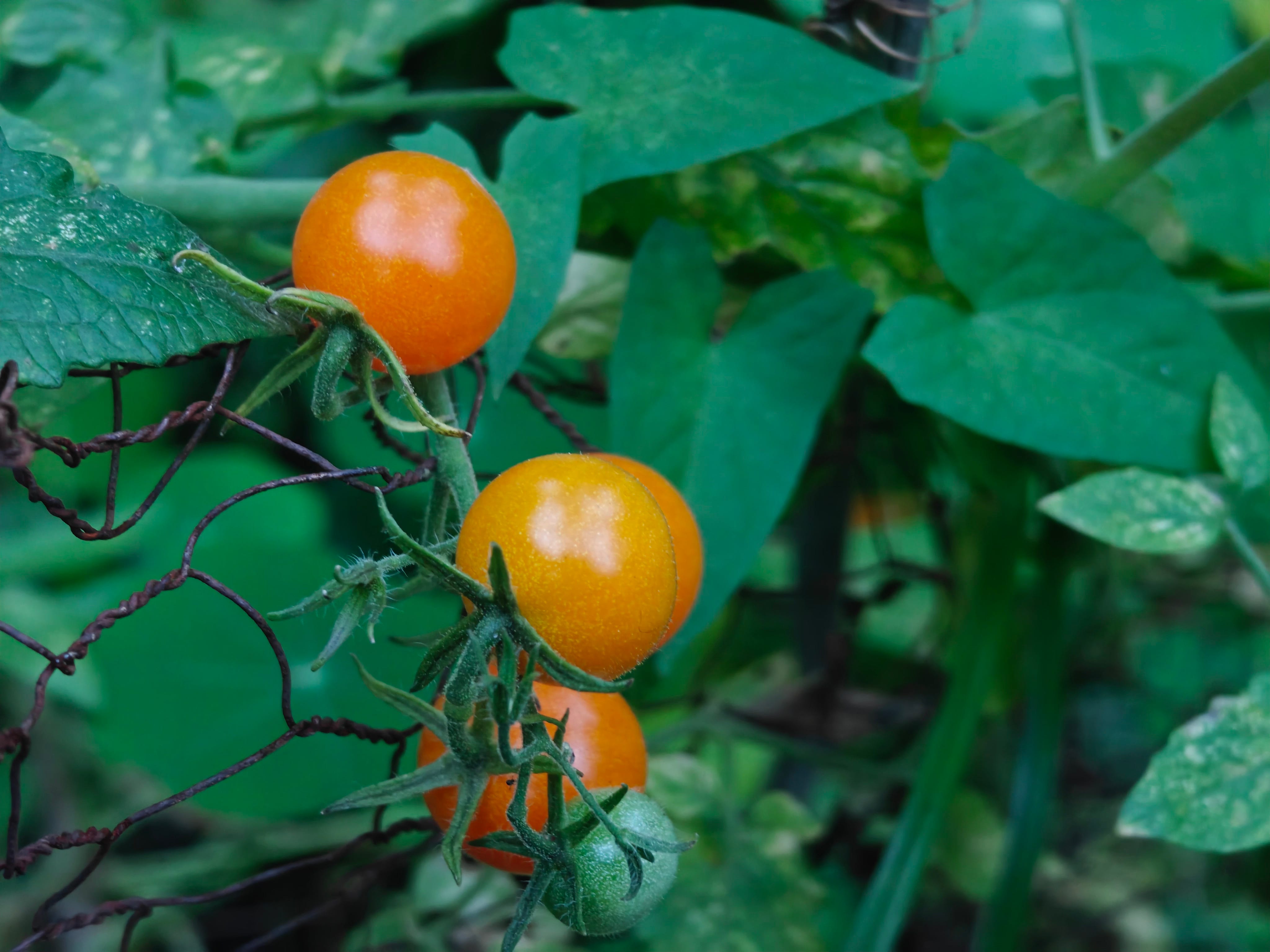
ripe tomatoes on a “volunteer” plant - self seeded from last year. It’s rare that fruit on volunteers gets to fully ripen, but this year we’ve had warmth well into October
Nom, I’m gonna make this and shall report back. Anchovies are the magic word! x
Anchovies, yes, what would we do without 'em? I know there are loads of people who claim to detest anchovies but I truly think they haven't given them a chance. Most all cooked tomato sauces can benefit from an anchovy or two squished into the heated olive oil before the tomatoes get added. Eeuw, it tastes fishy! No, it doesn't, not if it's done right. I'm getting hungry for anchovies on a crusty slice spread with unsalted butter, as good as ham, or better!