
We’re at another hinge point in the year, the summer solstice. And the first day of the Islamic new year arrived early last week, on Monday the 16th. In my personal space the summer signals are strong.
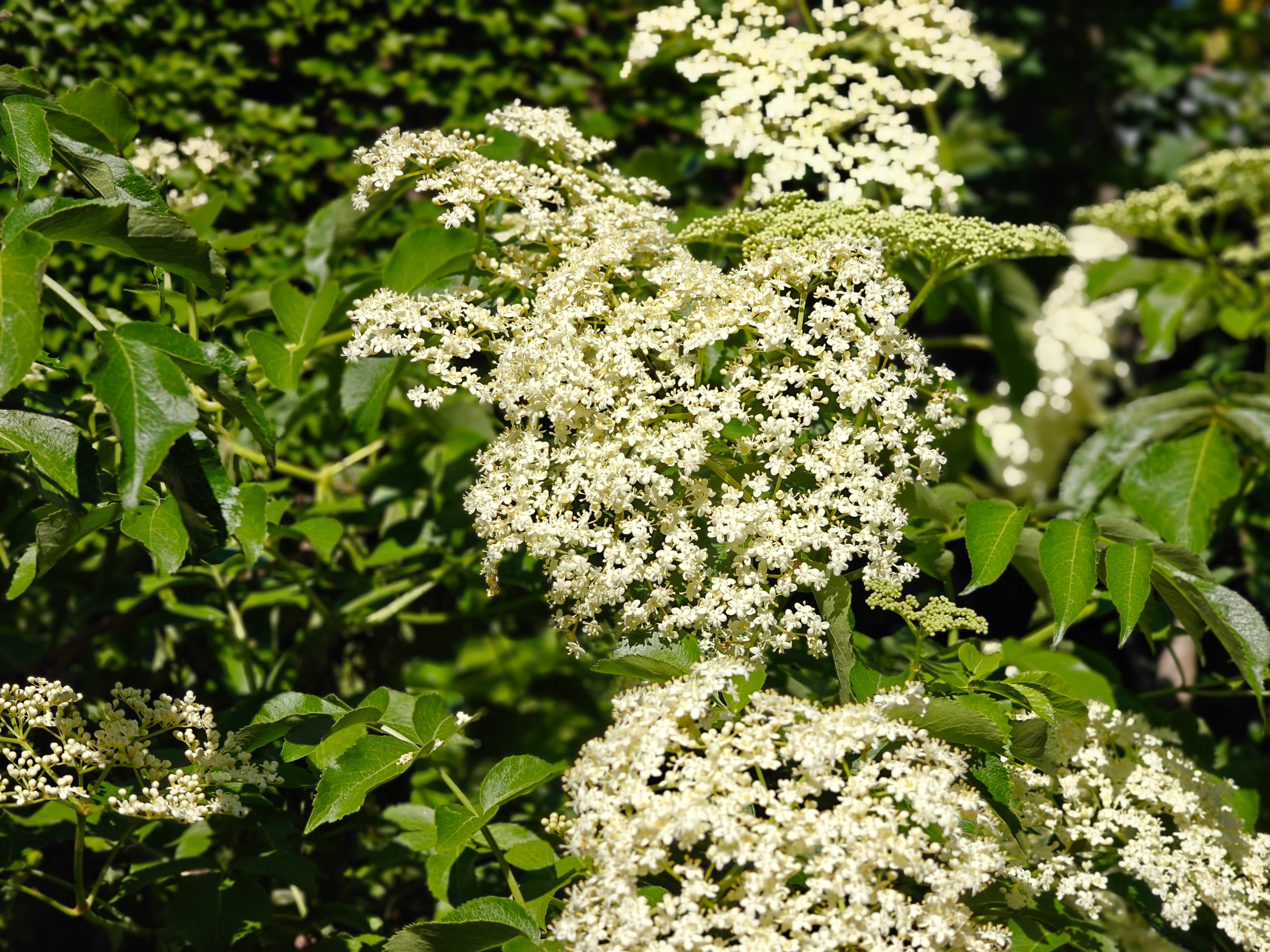
elderflowers galore
The elderflowers are almost fully out in layers of frothy white on the small tree we planted three years ago. And there’s a cascade of honeysuckle flowers along the side fence of the back garden. They attract the bees and other nectar drinkers, among them, yesterday, a stunning tiger swallowtail butterfly. I sat with on the shady side of the garden and watched the butterfly open its wings wide, in gorgeous display, as it fed on the honeysuckle blossoms.
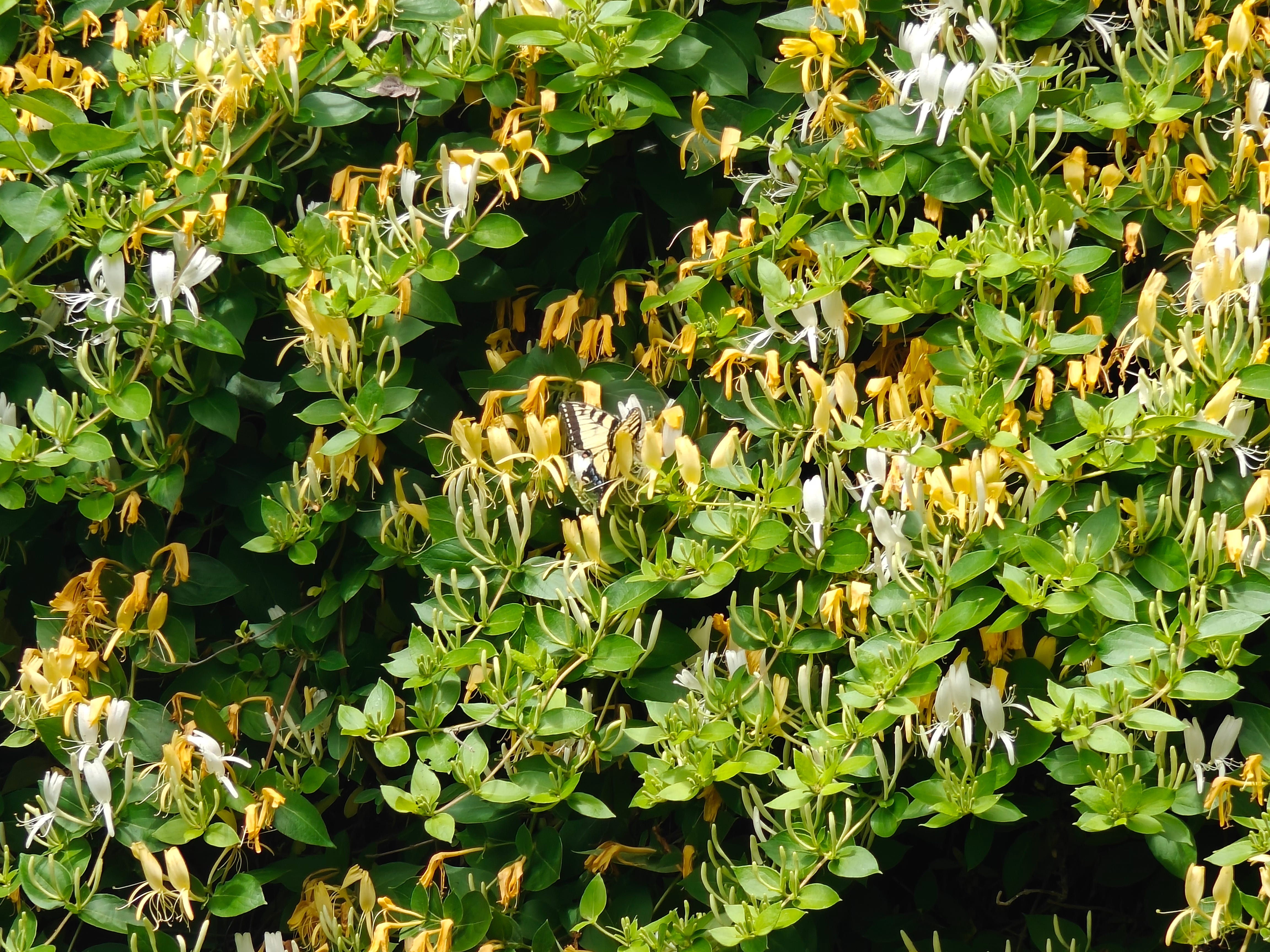
honeysuckle with butterfly at the upper middle
Meantime the black currants are fattening and their green is starting to darken to black. The same for the red currant bush, with its load of slightly smaller berries. The currants are a reminder that my being here, rather than traveling on my way to the Oxford Food Symposium, has a positive side: I’ll be around next week, when the currants should be fully ripe. It’s a small unexpected compensation for my disappointment.
As you can probably tell, I’m working at finding the positive in my changed landscape, rather than mourning the loss of my trip to the Symposium (and my plan to visit Shetland and Orkney). I’ve been remembering my first time in those far-northern places. It was November 1974. The North Sea oil had not yet started flowing, but work was going on to lay the undersea pipelines to the platforms. I stayed at a bed and breakfast in Lerwick where we were served unbelievably hearty breakfasts of fried bread, bacon, eggs, and perhaps potatoes too, I’m not sure. I just remember how welcome and warming all the bacon-fat was, for outside the air was damp and the wind penetrating. One of the other people staying was the guy in charge of laying that pipeline, so he had stories to tell. The Shetland I saw in those short chilly days (sunset was before 4 pm) was peaceful. Folk talked about how they expected they’d have to lock their doors once the oil started flowing...
And back to the present day in the garden: another small pleasure is the little bunny who has started to visit. He’s cautious but persistent, a persistence that I’m sure is related to the tender leaf lettuce growing near the garlic. He also nibbles other leaves, but I’m not sure exactly which ones.
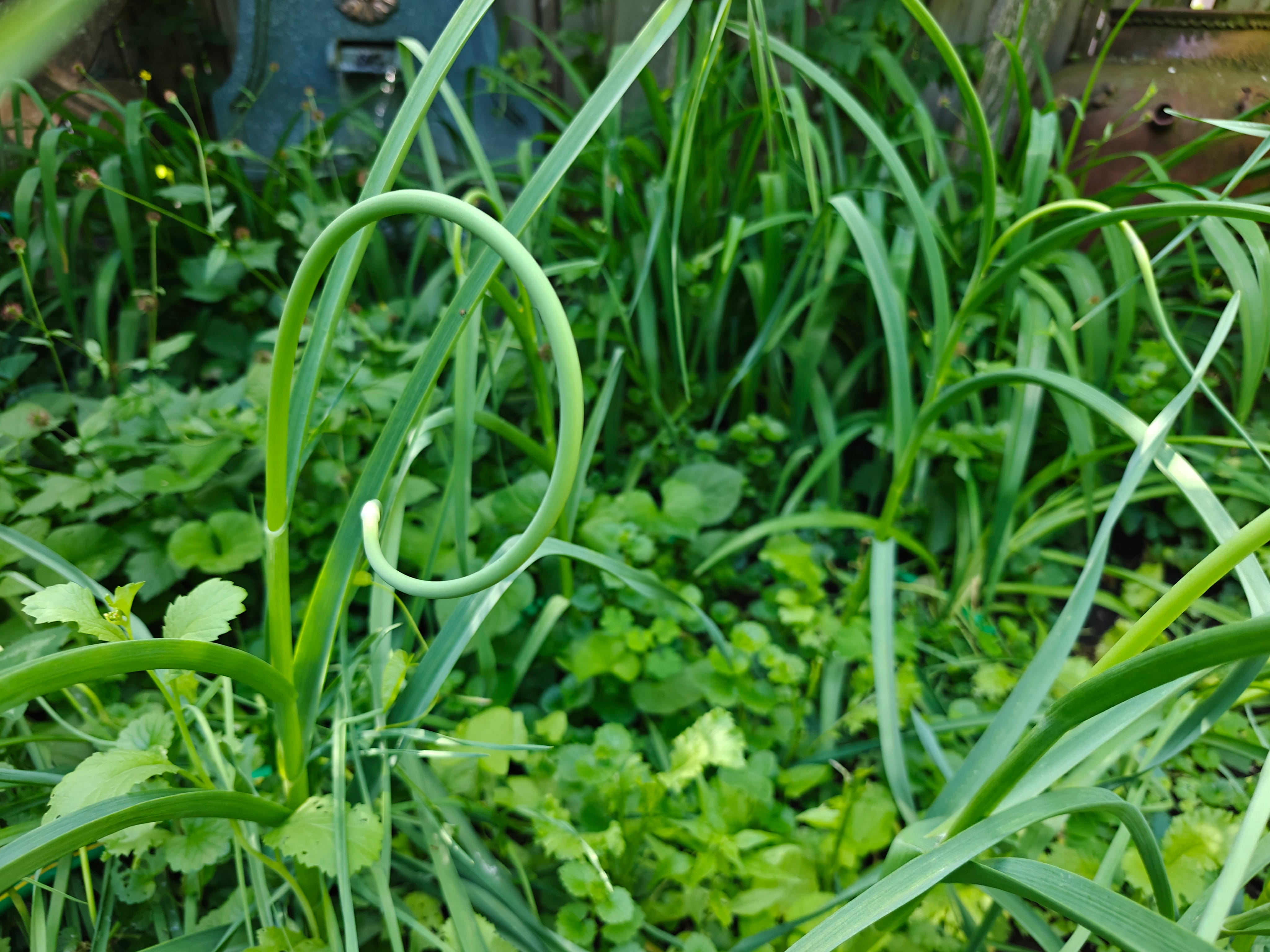
curving garlic scape, with some mustard leaves on the left
The two short rows of garlic I planted very late last year are now producing scapes, decorative curved green stems that carry tiny garlic seeds in a small pale capsule. They’re a gift to the cook, a harvestable bounty. I love snapping them off, the stem green and strong and firm enough to break crisply. (And you need to break them off so that the plant puts its energy into making a big garlic bulb you can harvest later, rather than into the seeds.) I don’t have a huge number of garlic plants (there’s one scape per plant), so I tend to chop the scapes and include them in stir-fried dishes or curries, for their fresh green garlic flavour and texture. At farmers markets they’re now available by the handful; try using them as a base for pesto.
The cool weather and the generous rain we’ve had recently mean that there’s still asparagus in the markets and everything else (cucumbers, potatoes, tomatoes, etc) is a little late. I’m not complaining. I’m grateful for the high-pressure weather system that is now giving us bright skies and relatively cool temperatures (lows of 16 and highs of 23). It’s invigorating, an invitation to cycle or walk or work in the garden, or to just sit out in the shade with a book listening to the birds.

evening sky at solstice
KITCHEN EXPLORATIONS: rescuing new potatoes from over-cooking, exploring agretti, and simple fish cookery
I bought my first new potatoes last week, a delicious very tender-skinned variety called Georgia, from John and Inge at Wychwood Market. They were freshly dug, with the fine clay dirt still on them. I put them in a wide pot and washed them rubbing them together vigorously and rinsing them off in three or four changes of water, until it ran clear. They went onto the heat with a little cold salted water and some fresh mint. Once the water boiled I covered the pot and lowered the heat.
But then I got started working on somethiing else, and of course left the potatoes cooking too long, so they were overly tender. Oops! No chance of firm lovely new spud texture here. And there was another issue: A bite of one small potato taught me that all my scrubbing had failed to clean them fully. The skins were so papery that the fine clay did not wash off completely. I had to strip off all the papery peel.
With the potatoes so soft, a hot cooked dressing seemed like a good idea, so into hot olive oil I tossed mustard seeds and nigella and then some fennel seeds, as well as a chopped green cayenne chile with seeds stripped out. Then in went a sliced red onion, followed, once it had softened, by chopped dandelion and mustard leaves from the garden. I used a little fish sauce as well as salt to season, then pressed the potatoes to crush them lightly. I added the cooked greens, plus a splash of cider vinegar, and tossed them all together. Chopped mint leaves went on at the last minute.
The leftover potatoes were a perfect base for my breakfast of eggs over leftovers the next morning.
One of the less common vegetables in the market these last two weeks is agretti, an Italian green (Soda inermisi) that looks like fine fronds with thin leaves like supple everygreen needles, that can be stripped off the slightly tough stems (and then scatter everywhere). Agretti has a lightly salty mineraly taste. (It was traditionally used in Italy and other places in the Mediterranean to make soda ash, used in glass-making). It’s been a new discovery for me.
You can eat agretti raw but I like it lightly cooked. A few days ago I added it to mushrooms late in the cooking. I’d loosely followed the method I learned from a cook in Azerbaijan to make the mushrooms (you’ll find the recipe in my Taste of Persia book). Start with a little olive oil in a skillet, add the chopped mushrooms and saute them briefly, then add some water and let them simmer. They release flavour into the broth. When there’s still some broth left, as it concentrates down, you add butter to enrich it. You can also include some dry wine and perhaps a splash of soy sauce for part of your seasoning. About a minute before I took the mushrooms off the heat I added a handful of agretti stripped from its stems. I loved the fine green needles in the dark mushrooms.
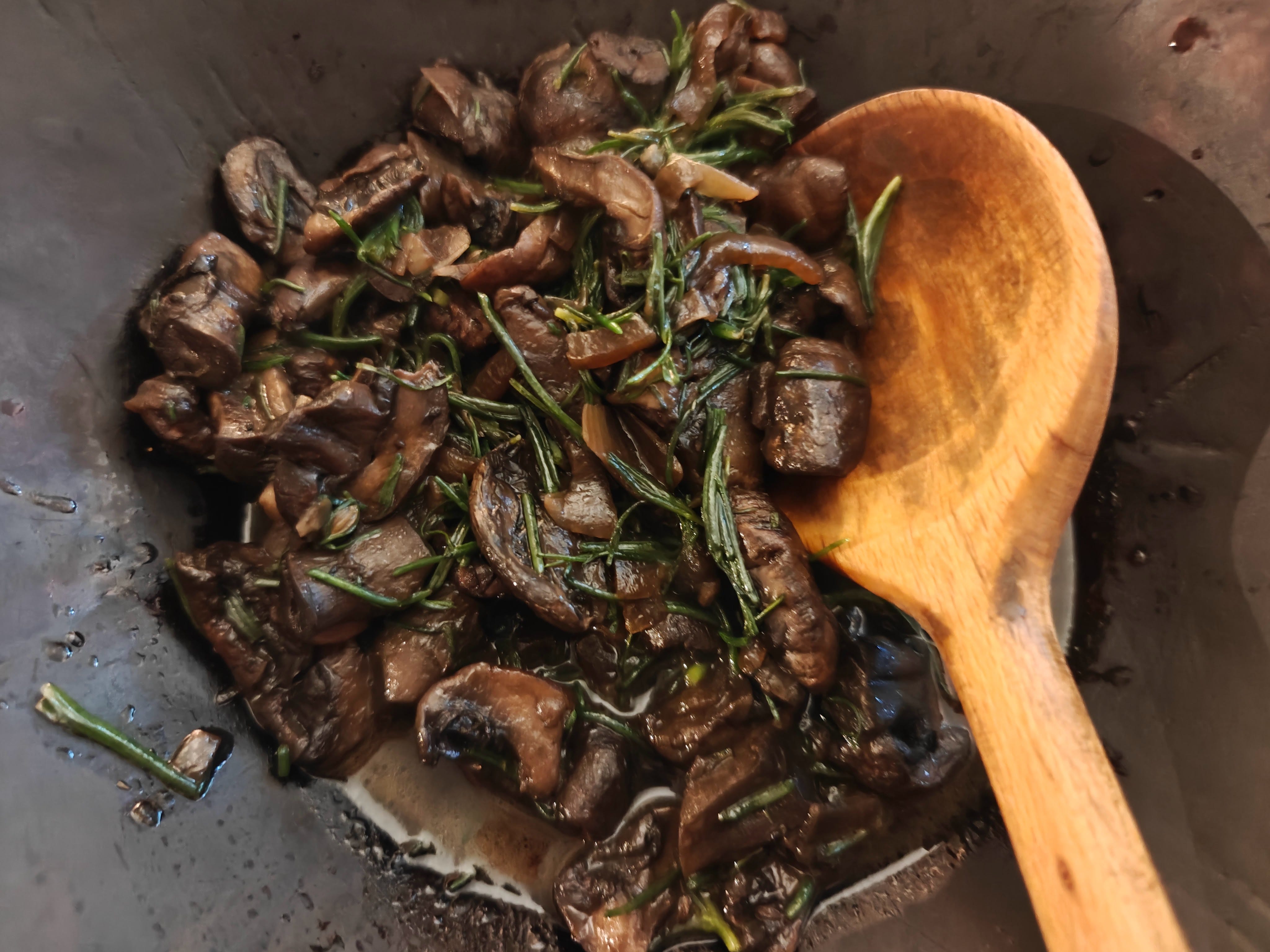
mushrooms cooked with agretti
I’ve also included agretti along with chopped garlic scape and some asparagus in a simple fried rice, made with leftover brown jasmine. It adds a little sparkle.
And finally, more on cooking fish. I cooked a lake trout fillet with a lot of sliced red onion, frying the onion gently until very soft, before adding the trout, which I’d smeared with a little shio koji. I do it skin side down for about 2 minutes on medum-high with the lid on so it steam-cooks a little, then turn it over for about a minute, and it’s done.
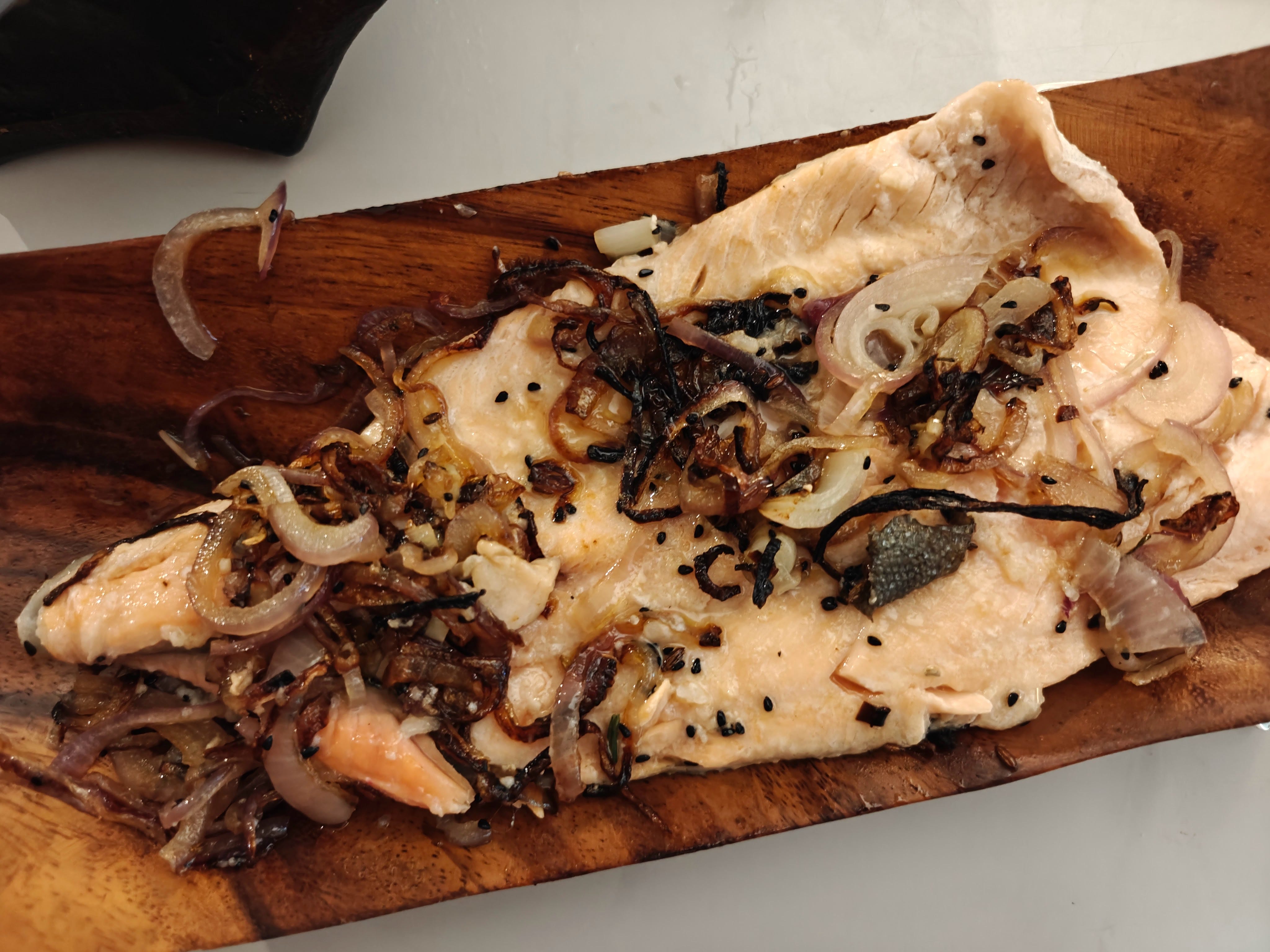
trout fillet with onions
The previous night I’d had some fresh halibut, a big treat. I stirred some home-made red miso into warm water, and started by adding sliced ginger to the pan in a little oil. The halibut went in skin side down. I poured the miso broth over and covered the pan to et it cook for about three minutes or so. Then I flipped it over for another short two minutes, before turning it out. The ginger-inflected miso was a wonderful complement to the fish, and didn’t overpower it.
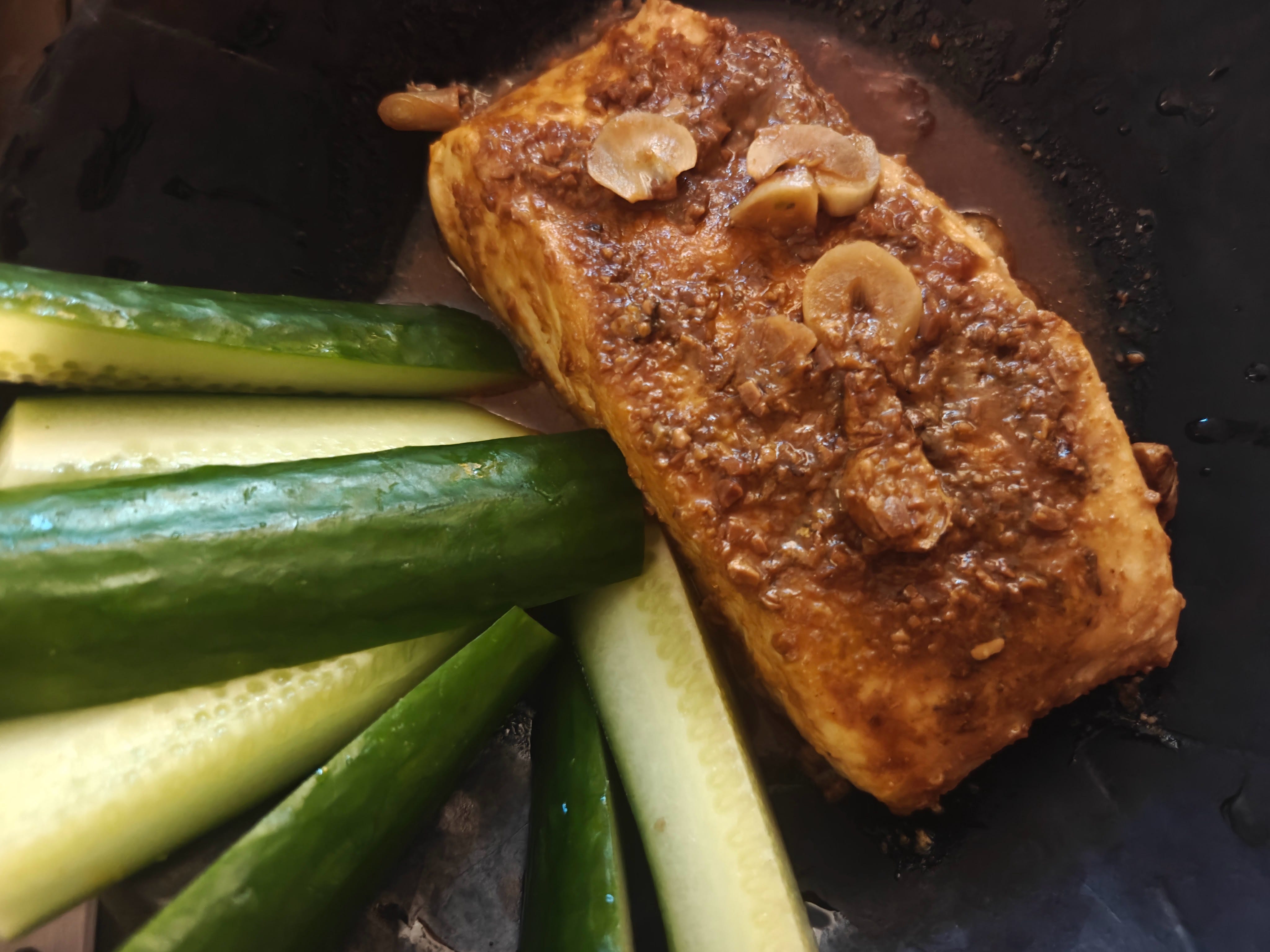
halibut coated in the miso sauce with pieces of ginger; and gorgeous new local cucumbers
There’s loveliness everywhere, if we have eyes to look.
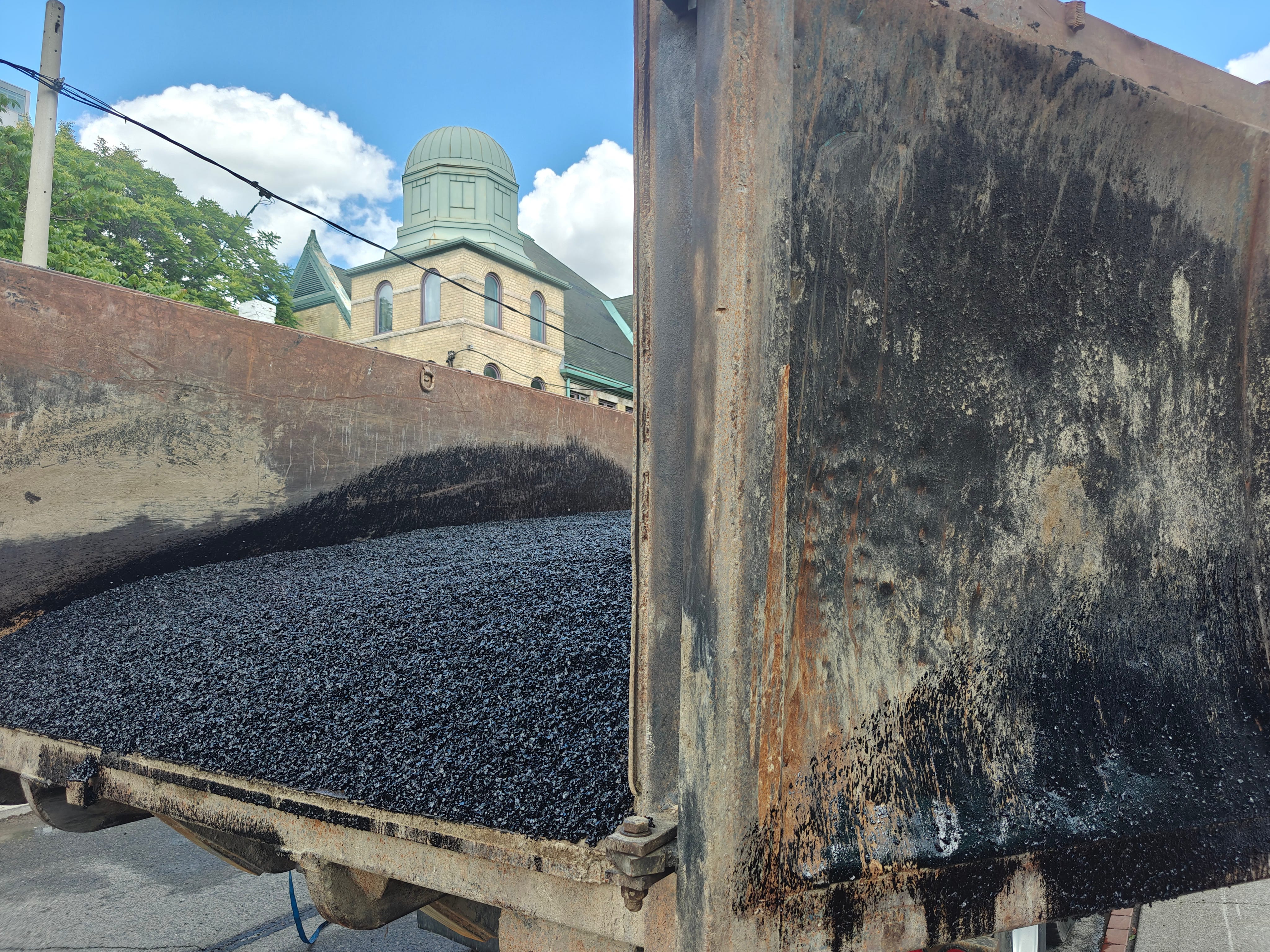
a shot of an asphalt truck in the neighbourhood, with a glimpse of the Cecil Street synagogue (now a community centre) behind, taken yesterday

and here’s the moon, halfway to full, a couple of nights ago, peeking through the huge maple tree that frames my view to the west
I had never heard of agretyi until now, and had to look it up. It sounds both fascinating and delicious.
Thank you for a lovely post again.
Im so happy to hear of agretti in your local market, Naomi. In tuscany we cook it in big bunches all in its own and eat it like early spinach with nothing but olive oil and a spritz of lemon. One farmer here occasionally has it but it’s rare and of course if no one knows what to do with it, no one buys it, and the farmer stops growing it—the way of the world. But that same farmer last week had fenugreek greens. Now what should I do with them apart from just steaming them? Advice, please.