
The month of June is moving toward the solstice. Clear skies yield to short bursts of rain and the garden is packed with green life. The wild rose bush is dotted with tender white blossoms, the clematis on the back wall continues to glow, and the mint and sorrel are on growth hormones.
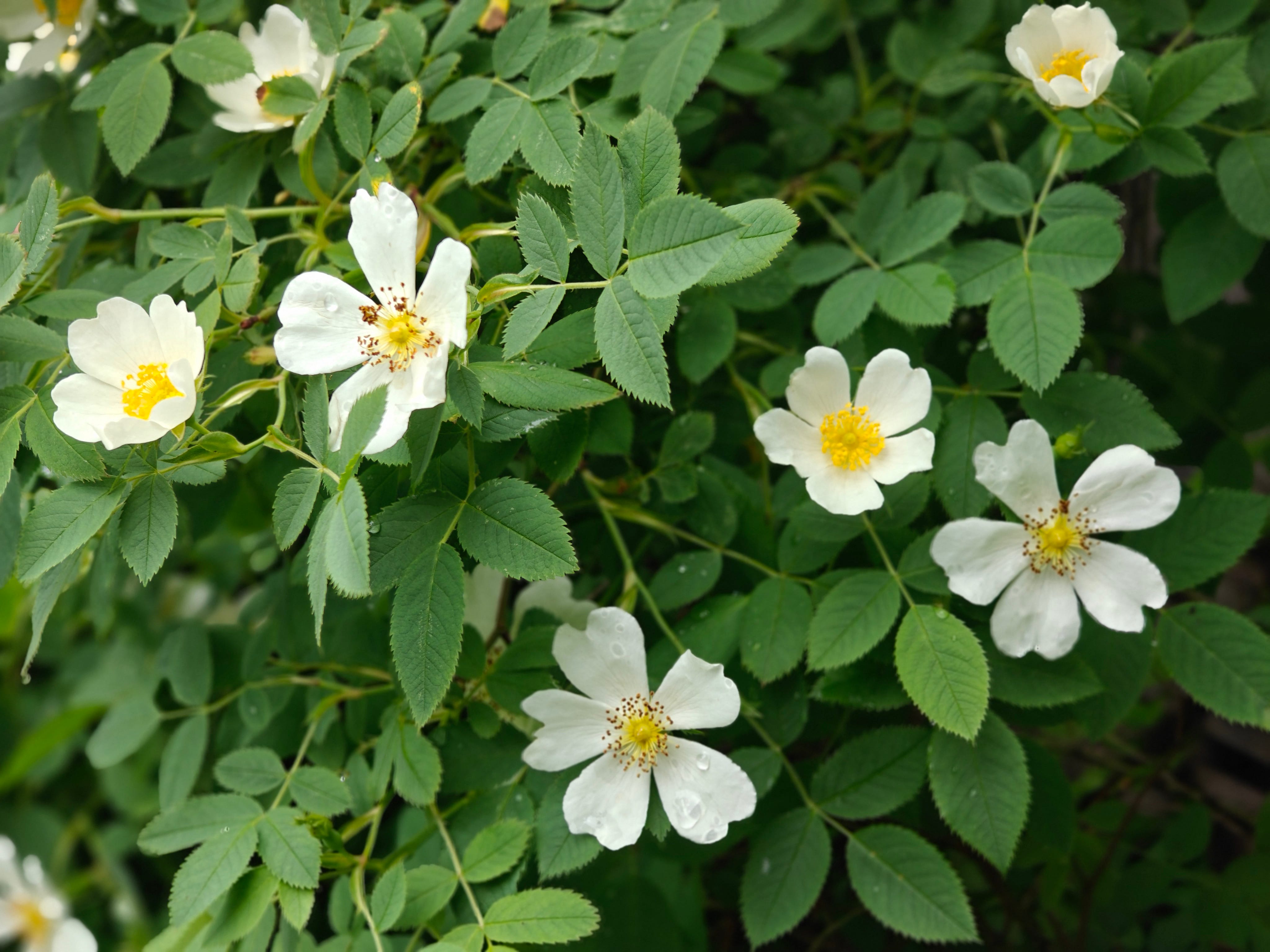
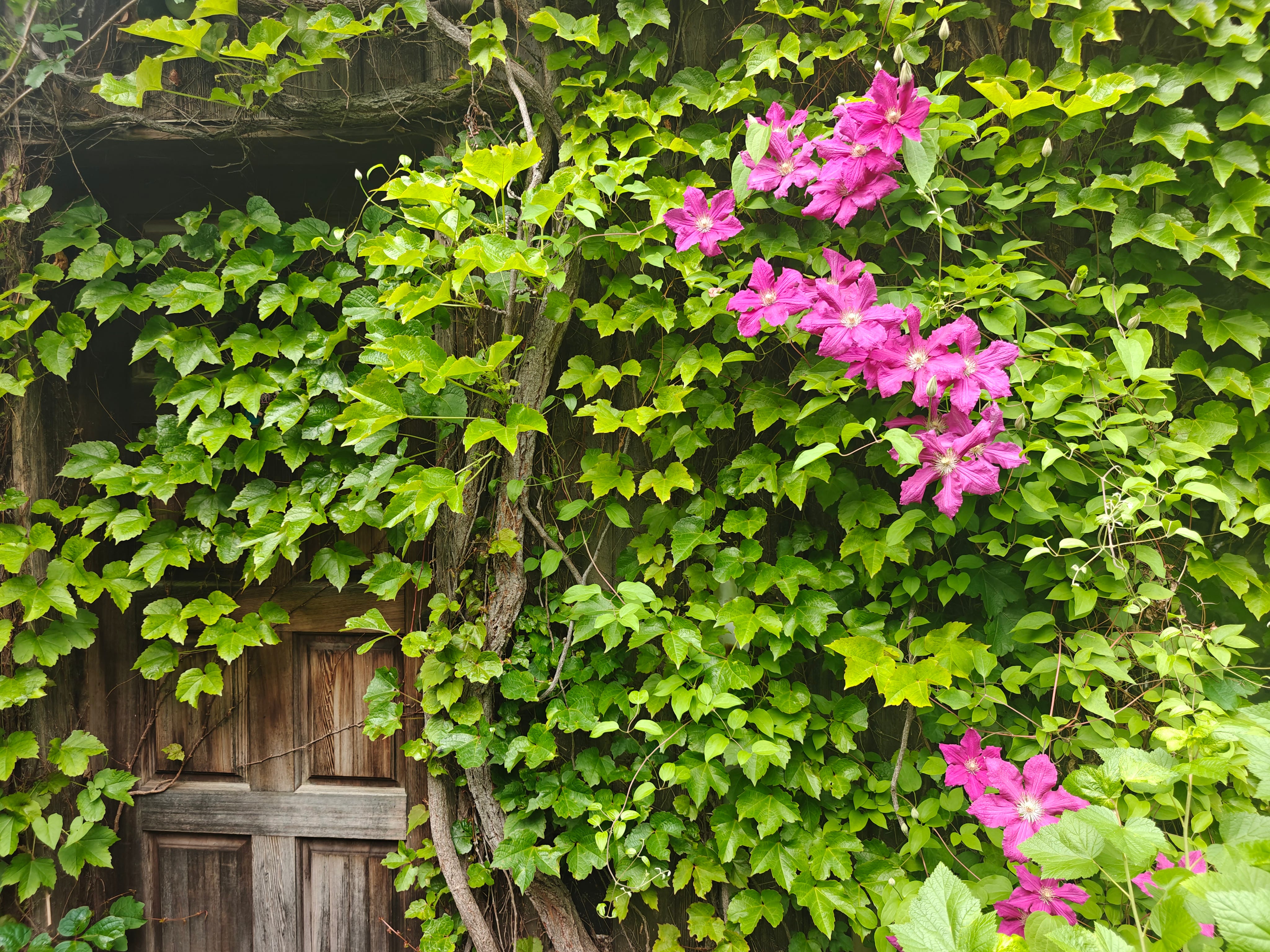
the rose in delicate blossom; the back wall of green ivy with clematis in vivid bloom
Toronto is filled with FIFA visitors, with streets closed, downtown sidewalks crowded, and café and bar patios packed. The games showing live on all the screens around town are a chance for everyone to forget the horrors of world news and their personal precarities, if only for a brief ninety minutes plus stoppage time.
At the pop-up flower market today at a park downtown there were brilliant colours everywhere, and a feeling of light joy as the crowd circulated, many of people already clutching two or three brown-paper wrapped bouquets.
Some complications here mean that I can’t go to the Oxford Food Symposium next month. It’s a hard truth that has weighed me down all week. It felt strange at first to feel more actively burdened by that setback than by my grief about Tashi’s death. But I’ve realised that the first sense of loss (when an expectation is confounded or a plan cancelled) can be very painful until the reality is integrated into an updated sense of the future. The disconnect between expectation and reality is an intense hurt that recedes once the mental landscape is rewired and adjusted.
Today things have shifted. Everything feels easier and less heavy as I start to picture different scenarios for the summer and fall.


shifting views in the the garden
I’m led, perhaps inevitably, to the truth of the Buddha’s insight that pain is caused by attachment (because attachment almost inevitably leads to loss or to disappointed expectation). The advice is to cultivate detachment, a calm frame of mind, unexcited by attachment and passion.
But surely it’s possible to love and be attached, whether to living beings or the status quo or future plans, and then to learn how to navigate the inevitable losses and disappointments that follow. Surely it’s possible, with luck and effort, to learn to ride the waves of life (not that I’ve ever surfed, but it’s a helpful metaphor here I think), with their unexpected thrills and highs and their sometimes crashing-down depths. Most people keep paddling in tough life situations and try to ride things out. Sometimes that feels impossible, for sure. But we seem to be hard-wired to try.
I was reminded yesterday evening of how much trauma and suffering many people undergo, and how much tenacity they need to survive. I was at a gathering to celebrate our friend Robina Aryubwal, who has now earned a Masters Degree from York University, after living for eight years as a refugee in Pakistan, and then finally arriving in Canada ten years ago with her parents and younger siblings. She talked about her childhood dream of getting an education, and how that was interrupted and frustrated by the Taliban and her family’s subsequent flight from Afghanistan into Pakistan. She never gave up. And nor did her family.
It’s been illuminating this week to think of short-term disappointments and setbacks as grief-inducing losses, losses that generate feelings that are echoes - call them younger cousins - of the enormous grief we feel at the death of someone we love. That deep grief surfaces unpredictably, a reminder of love. It did the other day when I was given a card listing the names of all the people who had donated to the CJC (the Community Justice Collective in Toronto) in honour of Tashi, as we’d suggested in his obituary. The names brought tears and a surge of grief and gratitude.


grief and gratitude: poppies in Toronto this week
KITCHEN EXPLORATIONS – with talk of Thai salads and cheese rehab as strategies for leftovers
Last Wednesday I was expecting three or four extras for supper. We had some beautiful lamb chops in the freezer that I moved into the fridge in the morning to defrost. And I put a batch of sticky rice to soak, a mix of white and black rices that then turns a gorgeous purple after soaking and steaming.
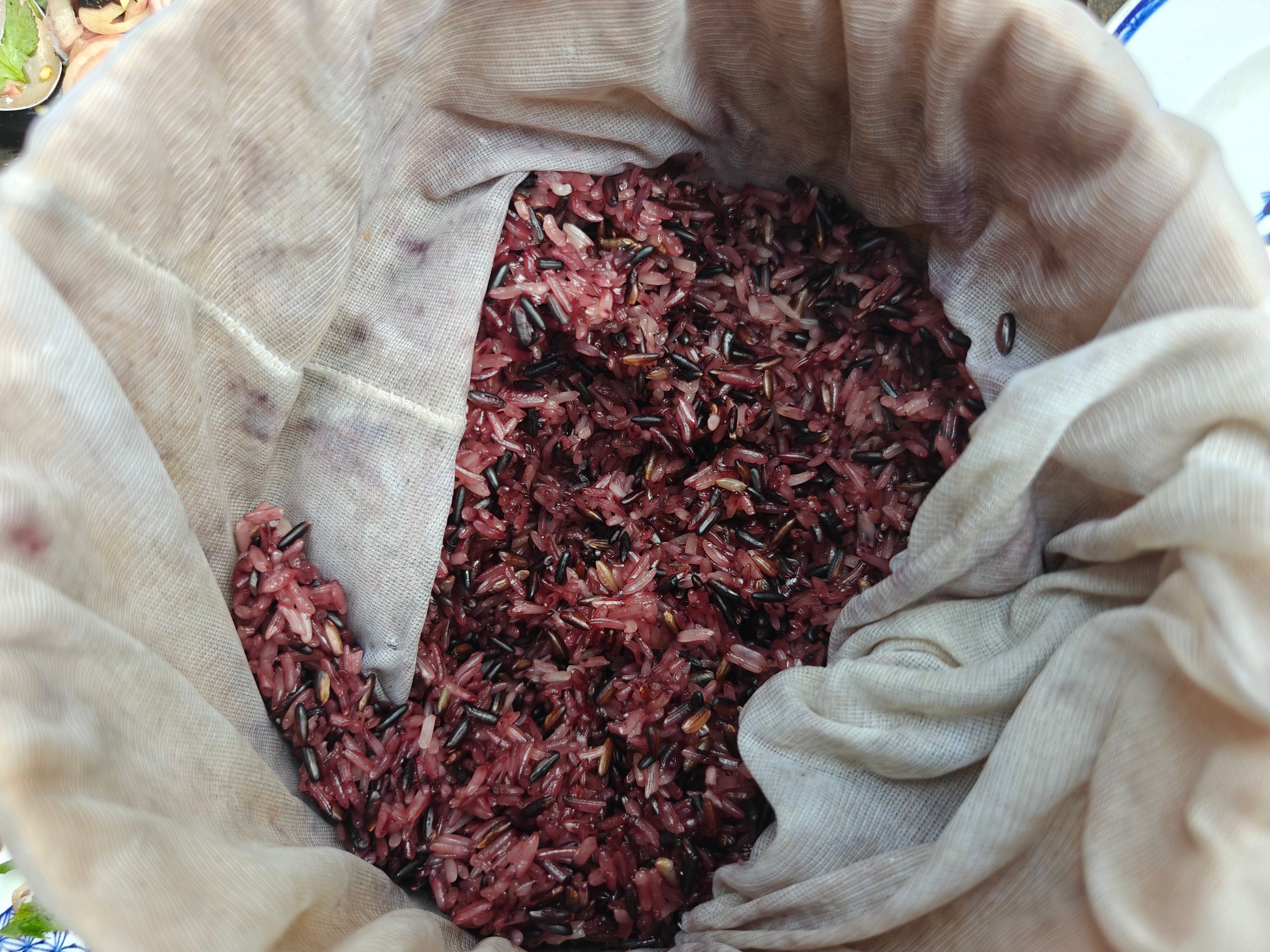
steamed sticky rice waiting to be grabbed by hand
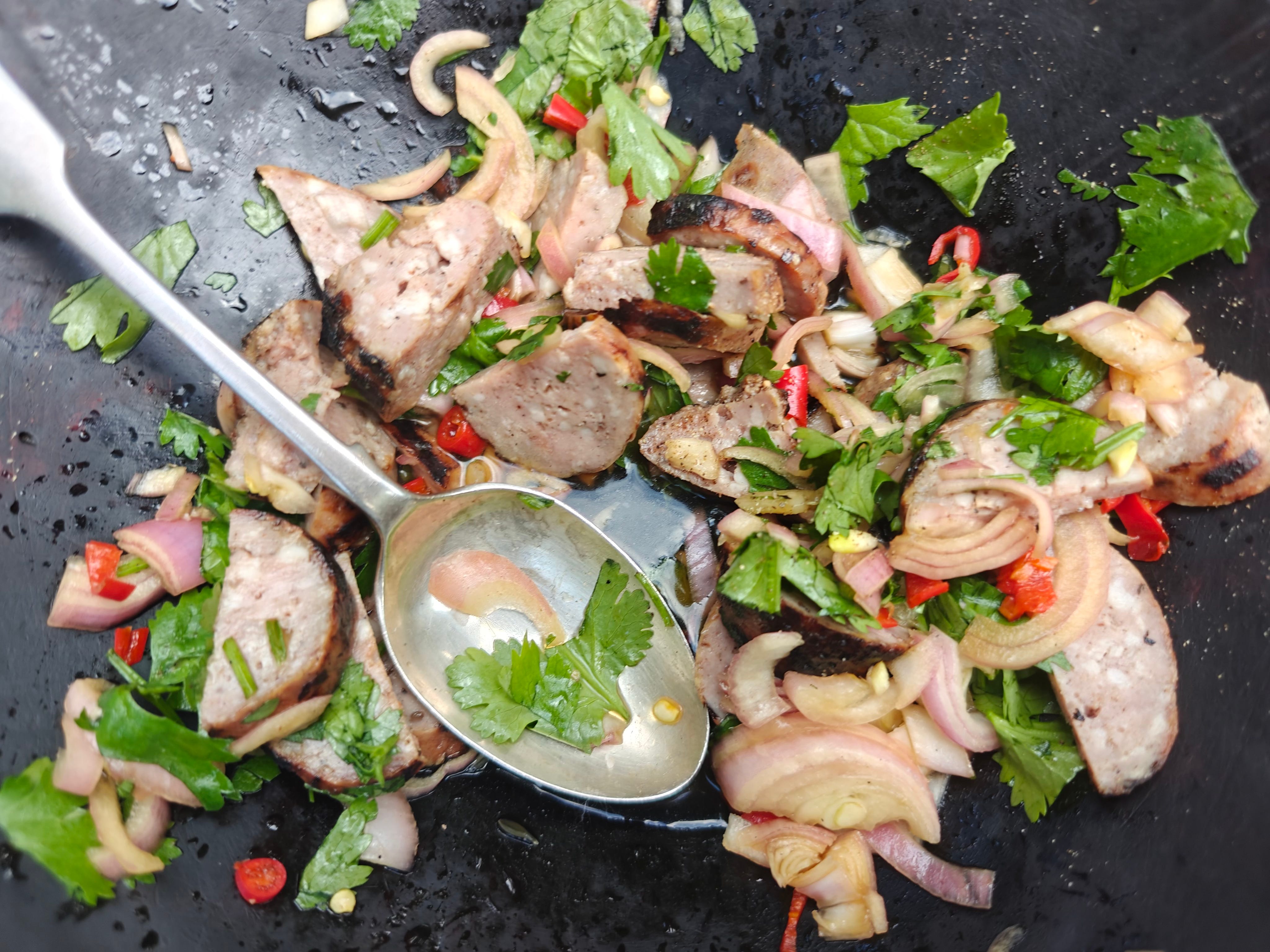
I also had leftover grilled pork sausage from the night before that could be transformed into a Thai salad. The strategy is a simple and useful one whenever you have leftover meat or fish. You need shallots, fish sauce, a few Thai chiles or substitute heat sources, the juice of 1 or 2 limes (or substitute lemons), and a splash of rice vinegar. I like to slice the shallots thinly, mince the chile(s) and then put them in a small bowl with the sauce: roughly equal amounts of fish sauce and acid (the citrus plus vinegar). After 20 minutes or more the shallots have taken up the sauce so that when you add them to your sliced sausage or other meat (you could also use age-tofu), they flavour everything beautifully. Top with chopped coriander leaves (cilantro) or mint leaves or rau ram, or a mix. (The other evening I had fresh coriander leaves from Footsteps Farm.)
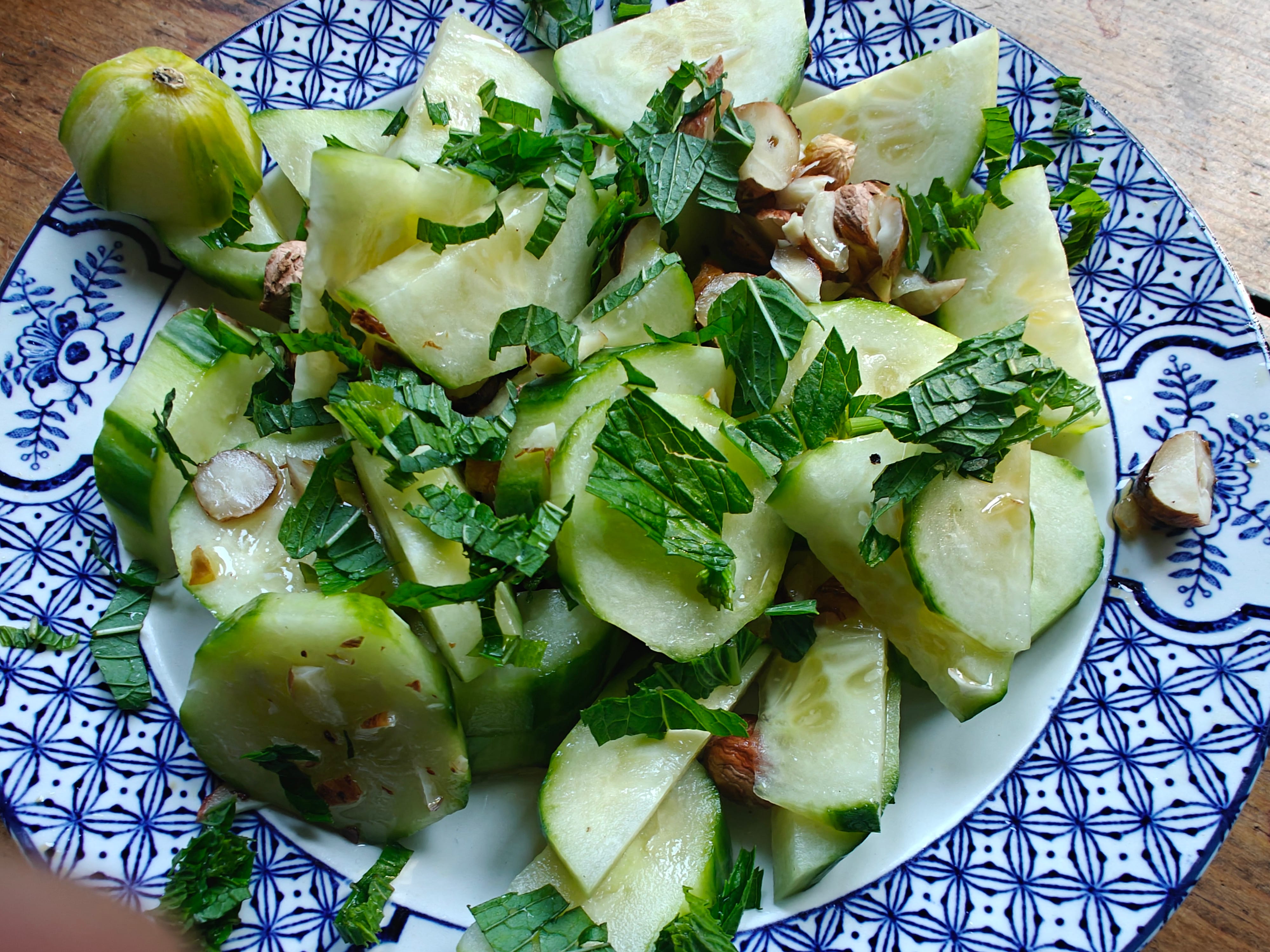
Because the sausage salad needed some balancing crunch, I made a second small tasty salad-ish dish of chopped cucumber dressed with sesame oil,, a splash of soy sauce, and a splash of rice vinegar, all topped with chopped mint from the garden. The salads were great scooped up with small handfuls of sticky rice.
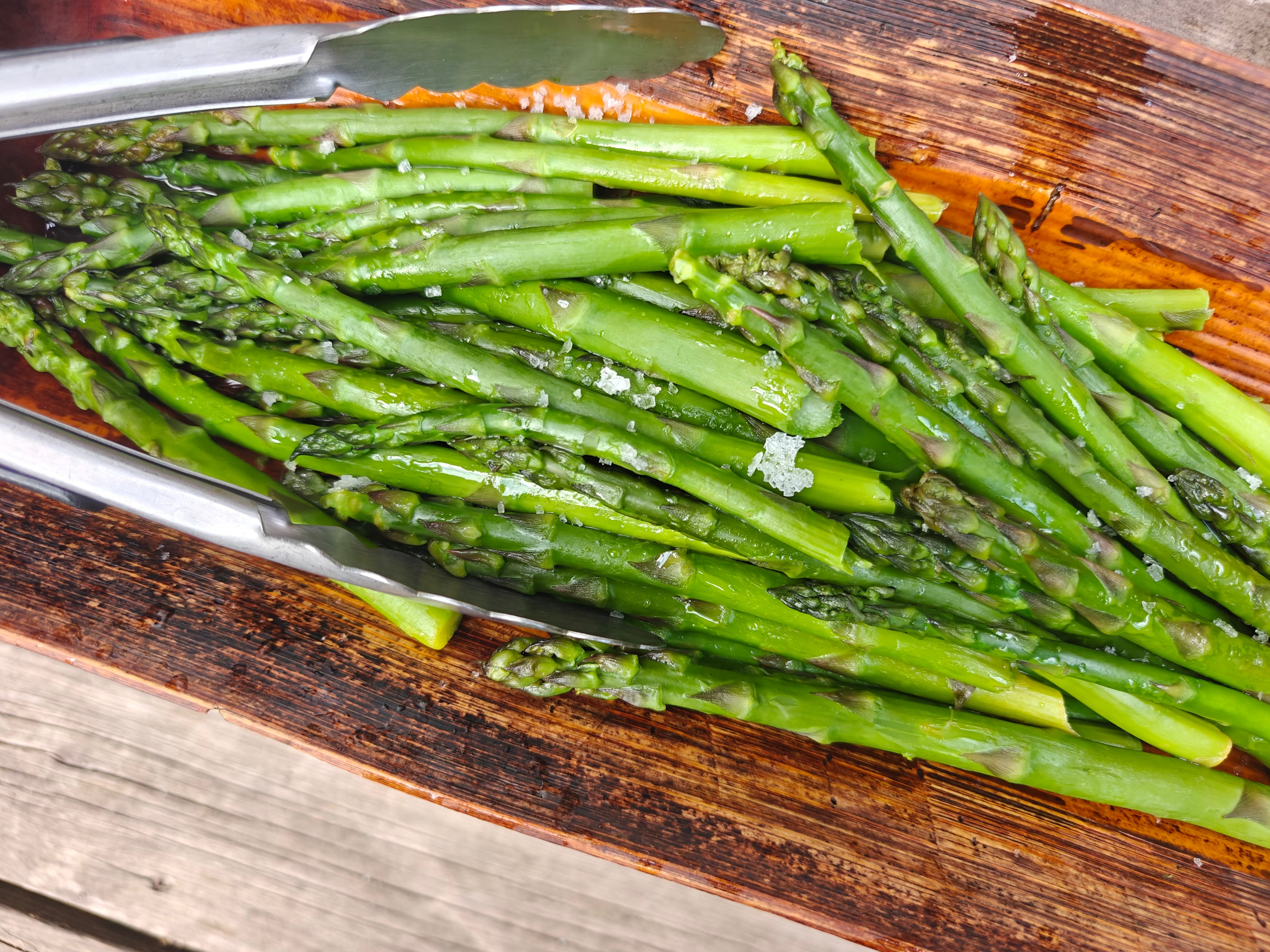
The lamb chops were marinated in pomegranate molasses, plus a little fish sauce and salt, and then charcoal grilled. And of course we had a huge pile of asparagus, simply dressed with olive oil and fresh lemon. We ended up eating the asparagus and the small lamb chops in hand too. Summer evenings with friends don’t get any better than that.
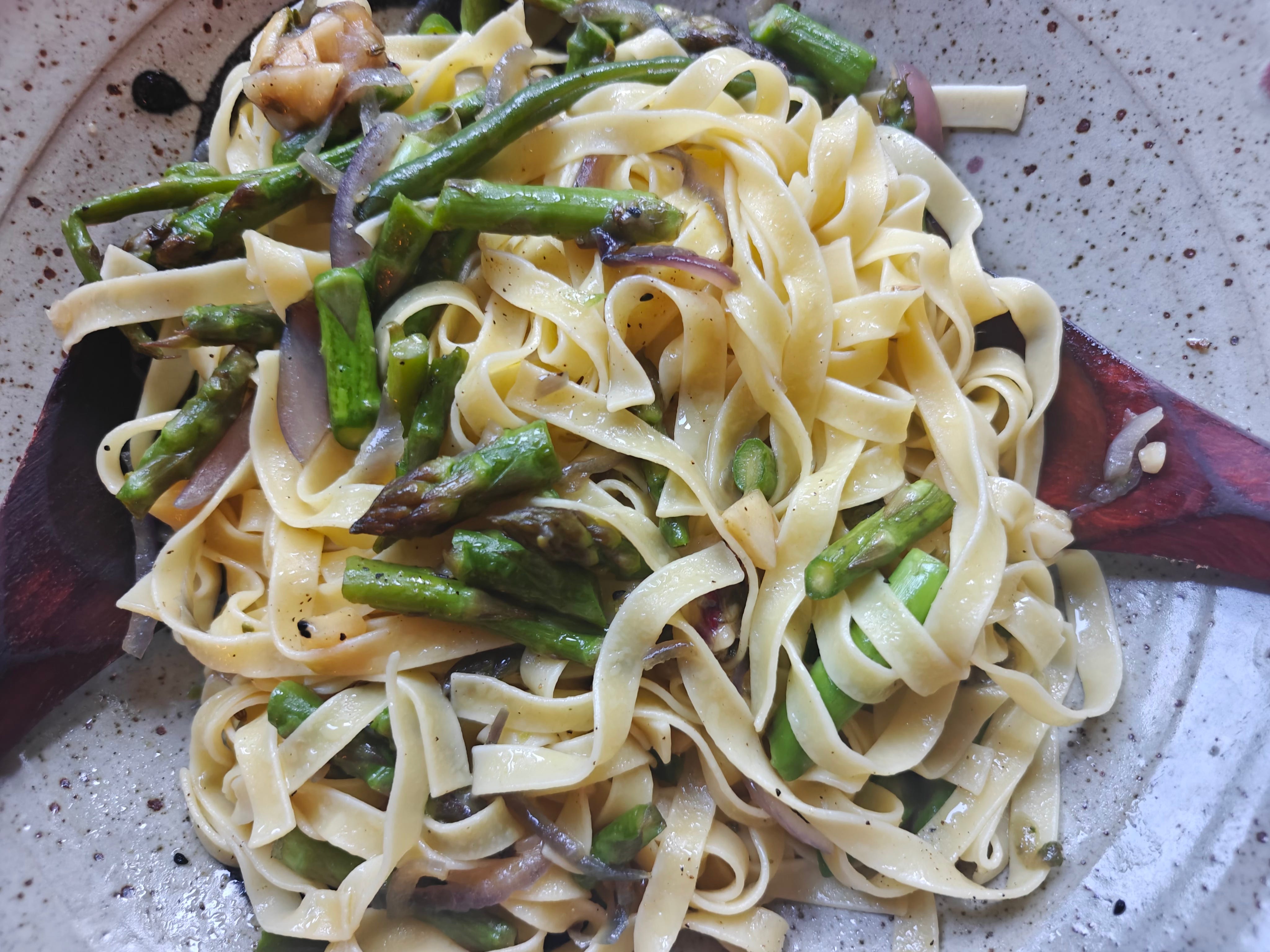
The day before I had found myself with a neglected bunch of asparagus, not in good enough shape to be eaten straight. How to use it best?
I trimmed off the tired stems, leaving shorter pieces, which I cut into roughly 1-inch lengths. In the end I resorted to an easy stand-by: Italian egg noodles. I began by cooking chopped red onion in a skillet with olive oil scented with a little fennel seed. Once it had softened I added the asparagus. After a brief sautee I added a little water, raised the heat, and covered the skillet. A few minutes later the asparagus was done. It went onto the just-cooked pasta and I tossed them together, along an extra drizzle of olive oil. Then I added some grated and finely chopped parmesan.
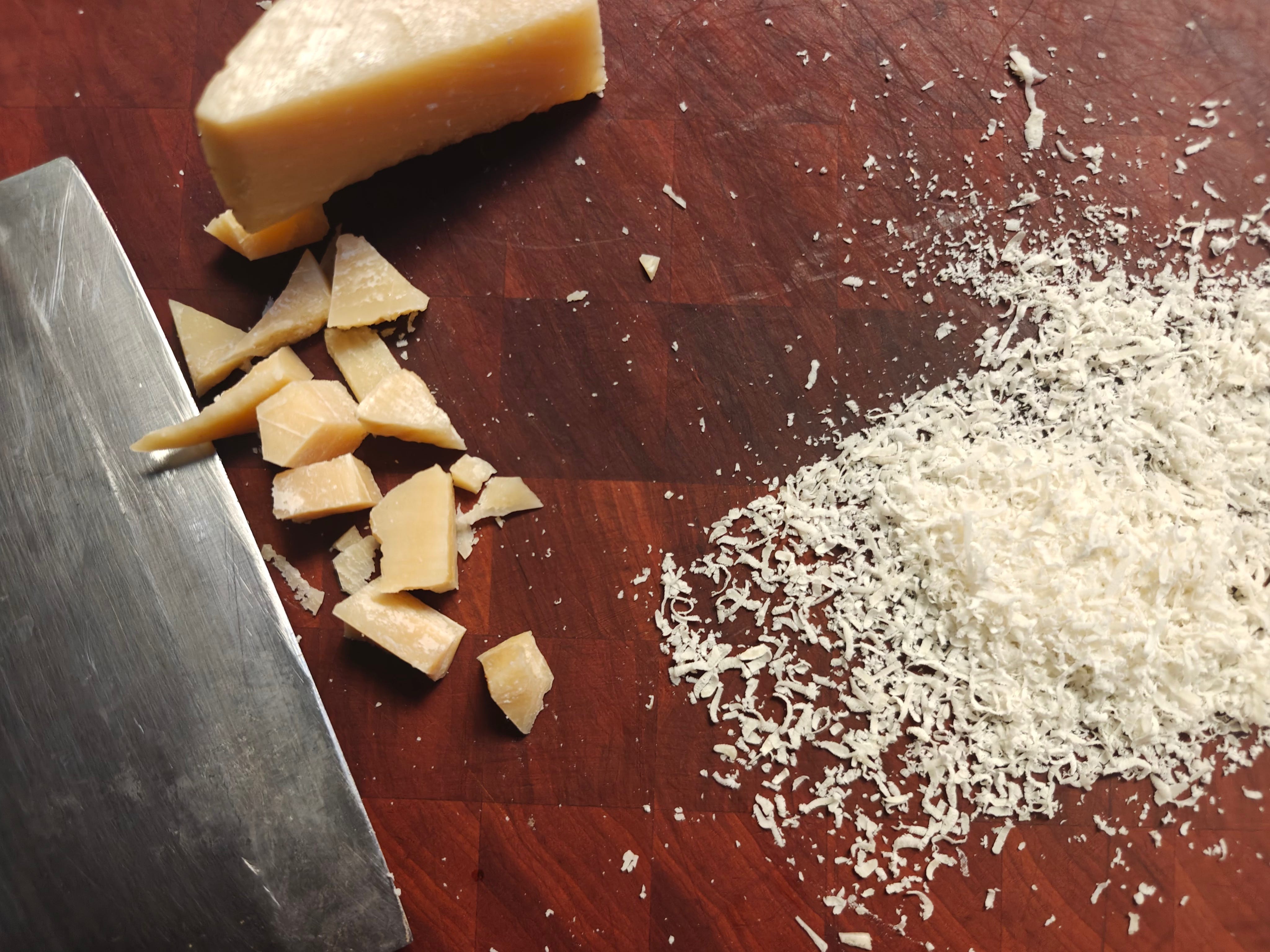
Like the asparagus, the cheese was a salvage/rescue operation. I had an end of parmesan in the fridge that should have been used earlier. It was too hard to grate comfortably, but it yielded to a cleaver. I sliced it and then chopped into ever-smaller pieces with the cleaver, so that they were fine enough to melt when tossed onto the asparagus pasta. It was a win all round.
I have been struggling with how to respond to this. The food related stuff is brilliant. I always feel out of place saying things like this to anyone who is grieving. Every time I see a photo of Tashi I catch my breath. He was so much a part of you, and an expression of you, as I'm sure your other son is who I've also never met is. And, who really wants to hear about dealing with impermanence and grief from a stranger? Anyway, I have too much respect for you to not share what I feel about what you wrote. Even just to communicate that I hear you.
I've always encouraged you to rage loudly, while you denied that being a need or objective. Expressions of sympathy from others like "so young, or too young to die", awkward or sincere expressions of sympathy, are often received as inflammatory or improper. But I'm beginning to sense the rage, on your terms and timeline. Your not being able to do something you had planned is very distressing. Do not internalize that.
Age can be a form of grief, and can also be accelerated by it. I like to kid myself I'm aging as disgracefully as I can, but I have almost no agency in the matter. That said, remember Buddha grieved. People often misinterpret Buddhism by blaming themselves somehow for a loss. They question whether they loved too much or too little.
I don't think Buddhism really teaches emotional detachment in the sense of being indifferent or unexcited. It's not about not caring. You didn't love too much, or somehow fail to live up to a Buddhist ideal. I think you're right that we love people, places, plans, and hopes, and then have to learn to navigate the losses and disappointments that come. Always. The other choice is withdrawal and paralysis.
Your riding the waves metaphor is very Buddhist. Balance or equanimity is allowing experiences to arise and pass without trying to hold on to the pleasant or push away the painful. What creates suffering is our very human tendency to demand permanence from impermanence, even after the fact.
Suffering doesn't come from loving, but from wanting what is changing to remain unchanged. Everything we love is changing and cannot be possessed. That's a painful thing to accept. Every time it happens.
Your grief over losing Tashi is not a failure, or an indictment that you loved him too much, or a small thing. Buddhism does not see it that way either. Even the Buddha grieved losses. The question isn't whether grief happens, but whether, over time, we can learn to live with it rather than deny it.
Living isn't withdrawal from life, but participating in it. Change is constant. We just learn, slowly and imperfectly, how to live. Eventually it ends. When it ends. Discretion always gets you nothing. Rage, brave warrior. Live the fuck out of life, scars and all.
You’ll be much missed at Oxford Symposium this year, beloved old friend (and co-Trustee for more years than either of us care to remember). We’ll all keep you posted, anyway. Next year if not sooner!