
It’s just not possible, that Tashi is not around to respond to my thoughts, our thoughts, to hear us, to give us his thoughts, a slow smile, a pause of understanding. I can’t stand it, this void, this absence. It’s hitting me hard and pretty frequently right now. Maybe it has to do with the arrival of more sunshine and light, an expansiveness out in the world as we move fully into April, and the harsh realisation that Tashi is not here to share it.
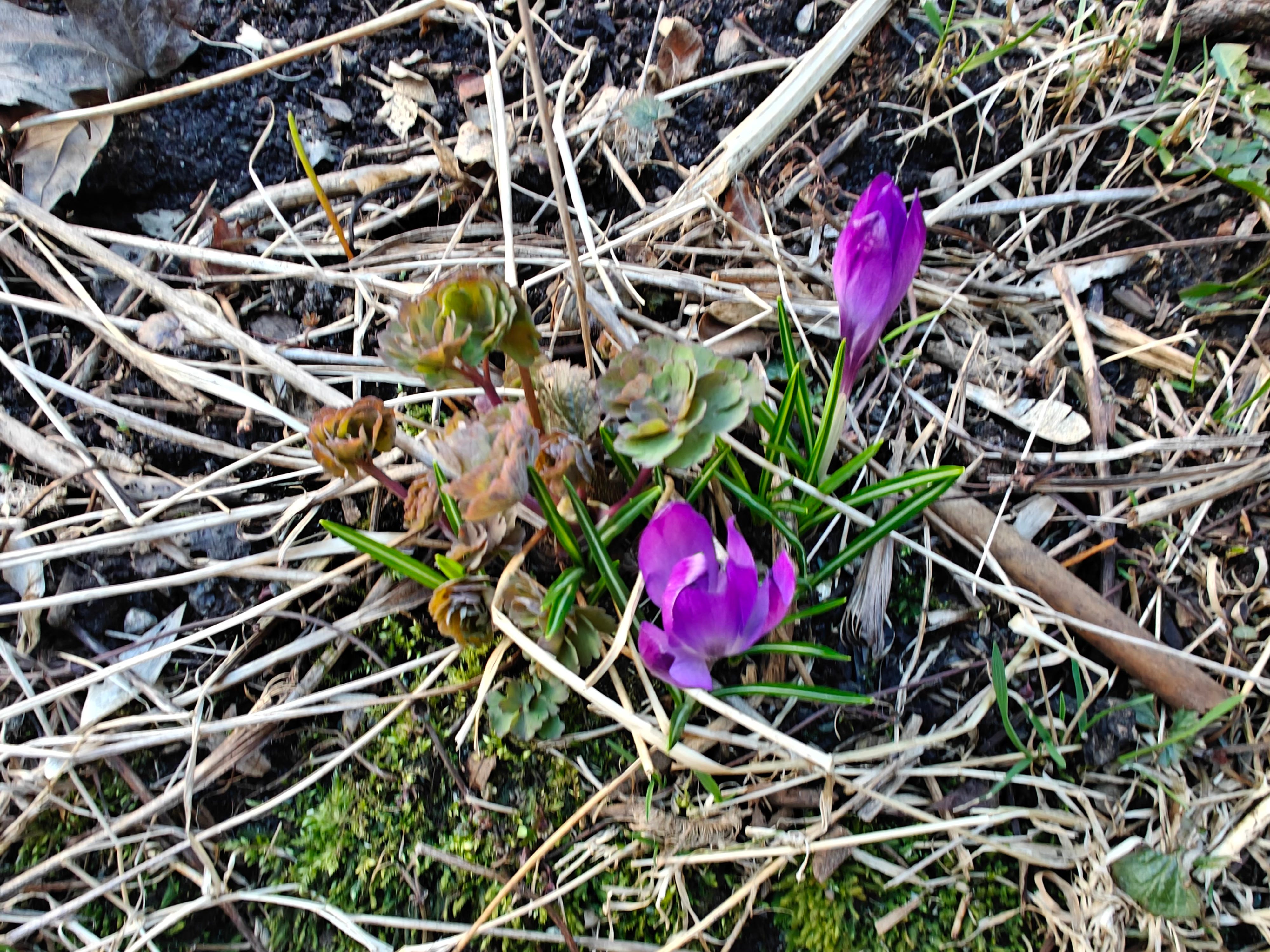
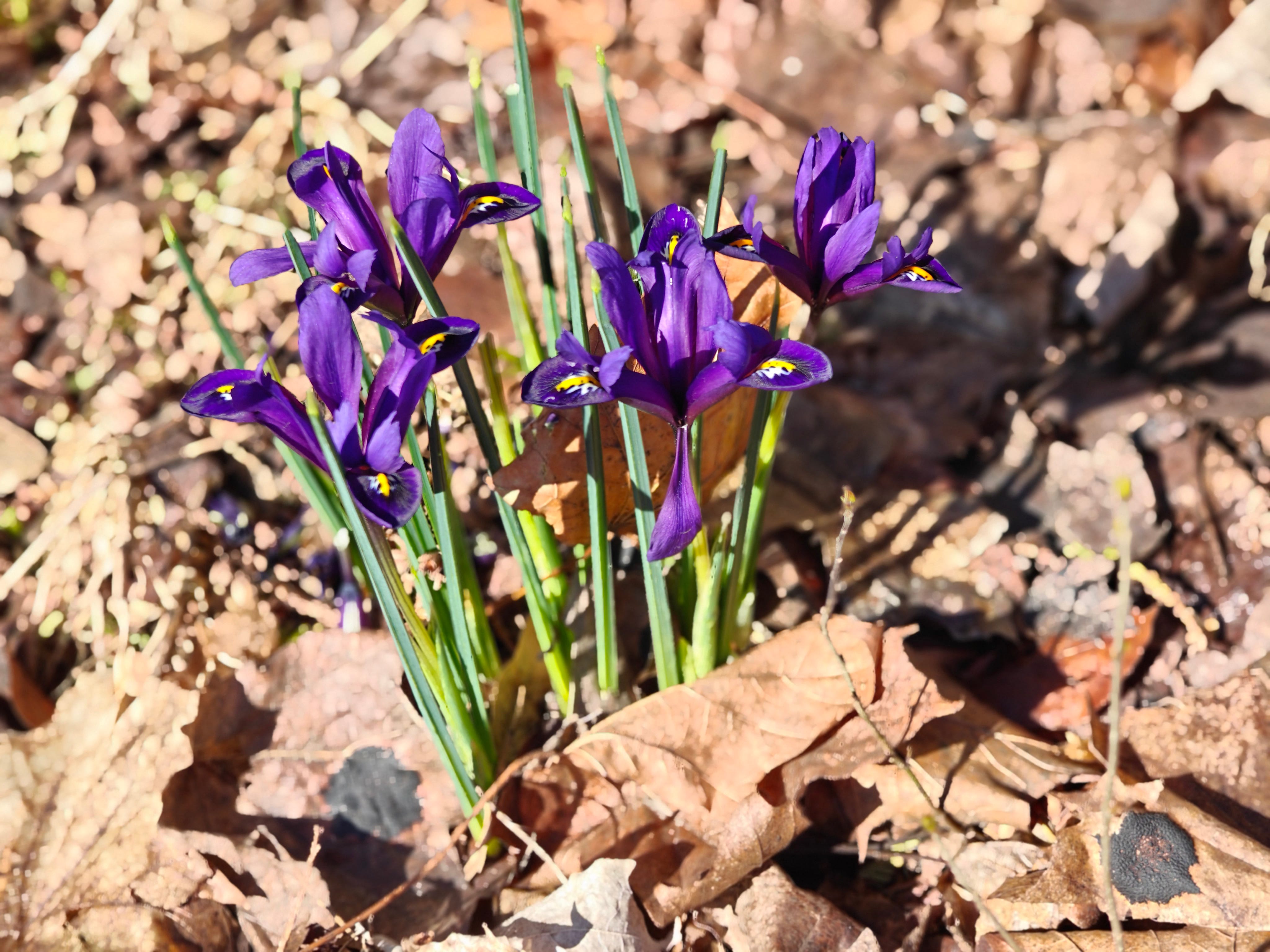
crocus and first columbine leaves in the garden yesterday
Once I acknowledge this absence, this hole in my universe, there’s nowhere to go except to tears and bereftness. Then the intensity subsides, I pick myself up metaphorically, and I start thinking about tasks I need to do, or plans for supper, or whatever.
We can’t live every minute, every hour, with the awareness of the void or the emptiness of absence. But it’s there and intermittently comes back to hit me hard. Is my psyche, my body, my subconscious, learning from these repeated blows inflicted every time I come up against the raw truth of this void? It doesn’t seem so. Each time feels as raw as the last time: utterly unacceptable and unbelievable.
I think that in the early months after his death I felt like he was still around in some way. In some ways his death felt like a continuation of the last eighteen months of his life, when he was living here with me. I felt immense grief, but there wasn’t a sharp sense of absence.
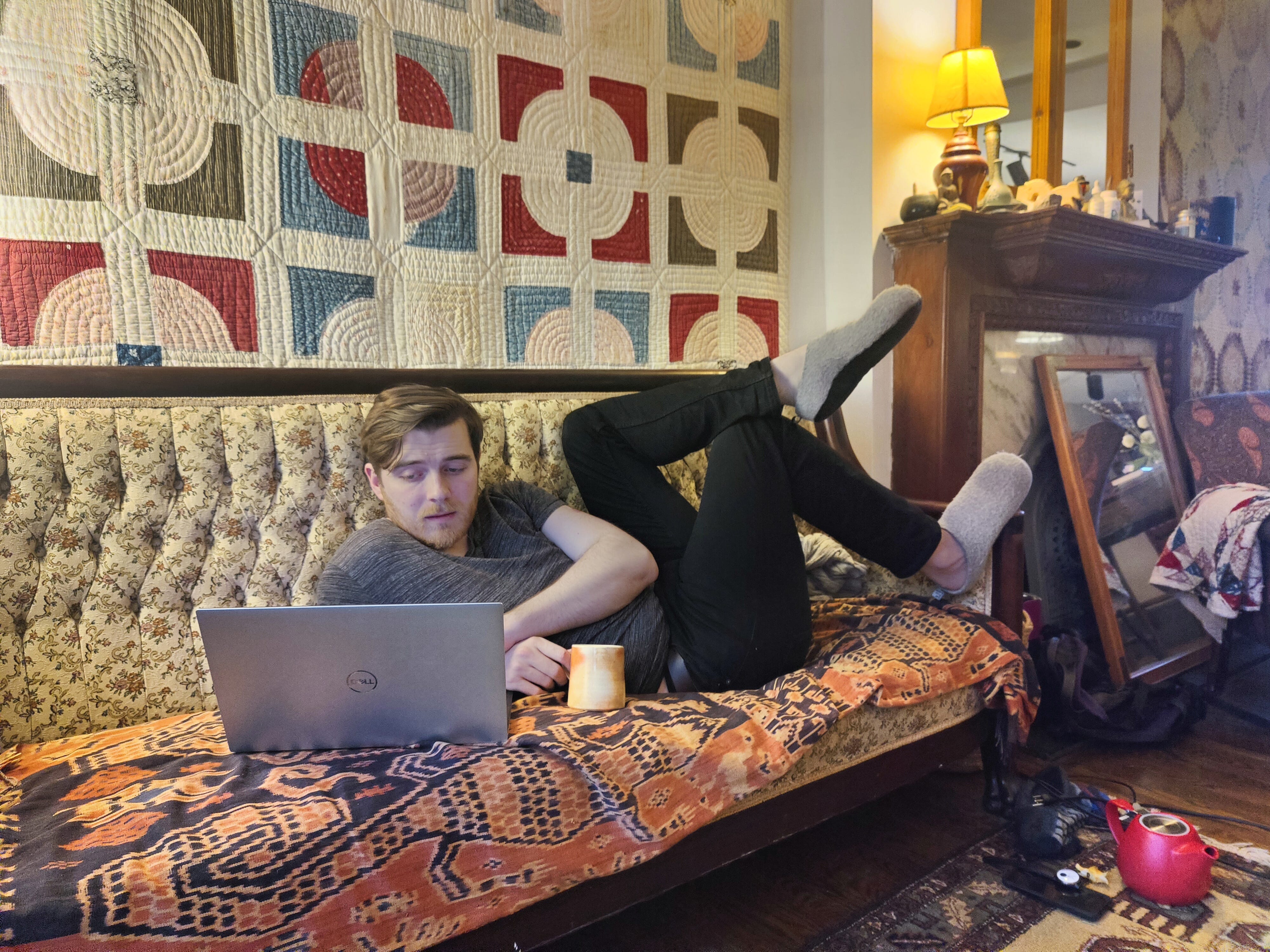
hanging out in the living room
Things have changed over the last few weeks. Maybe the arrival of spring signals that Tashi’s last year of living and suffering is truly over. Now I feel his full absence. The solid tuned-in Tashi we had for years, the fab guy with humour and grace and thoughtful loving judgement, is gone. It’s unbearable right now, this heavy fresh sense of loss that’s like a first contact with another layer of reality.
Have I just been skating on the surface of grief until now? Am I at last swimming in the sea of grief? And feeling the waters threatening to submerge me completely?
Or maybe, to stay with the metaphor, it’s that I can’t touch bottom. I am adrift in deep waters, and I am forced to admit to myself that I’m here forever. Tashi is not going to reappear, to rescue me from this sense of loss. He is truly gone.
I should be grateful to be in touch with this terrible reality, rather than gliding in a pretend world of fake all-rightness. This is life. Life is joy and also pain. It’s discovery and also loss. We hide it from ourselves and from each other in the day to day, so that usually it’s impossible to know whether the people you walk by on the street are feeling safe and contented or are instead suffering acutely from grief or fear and anxiety.
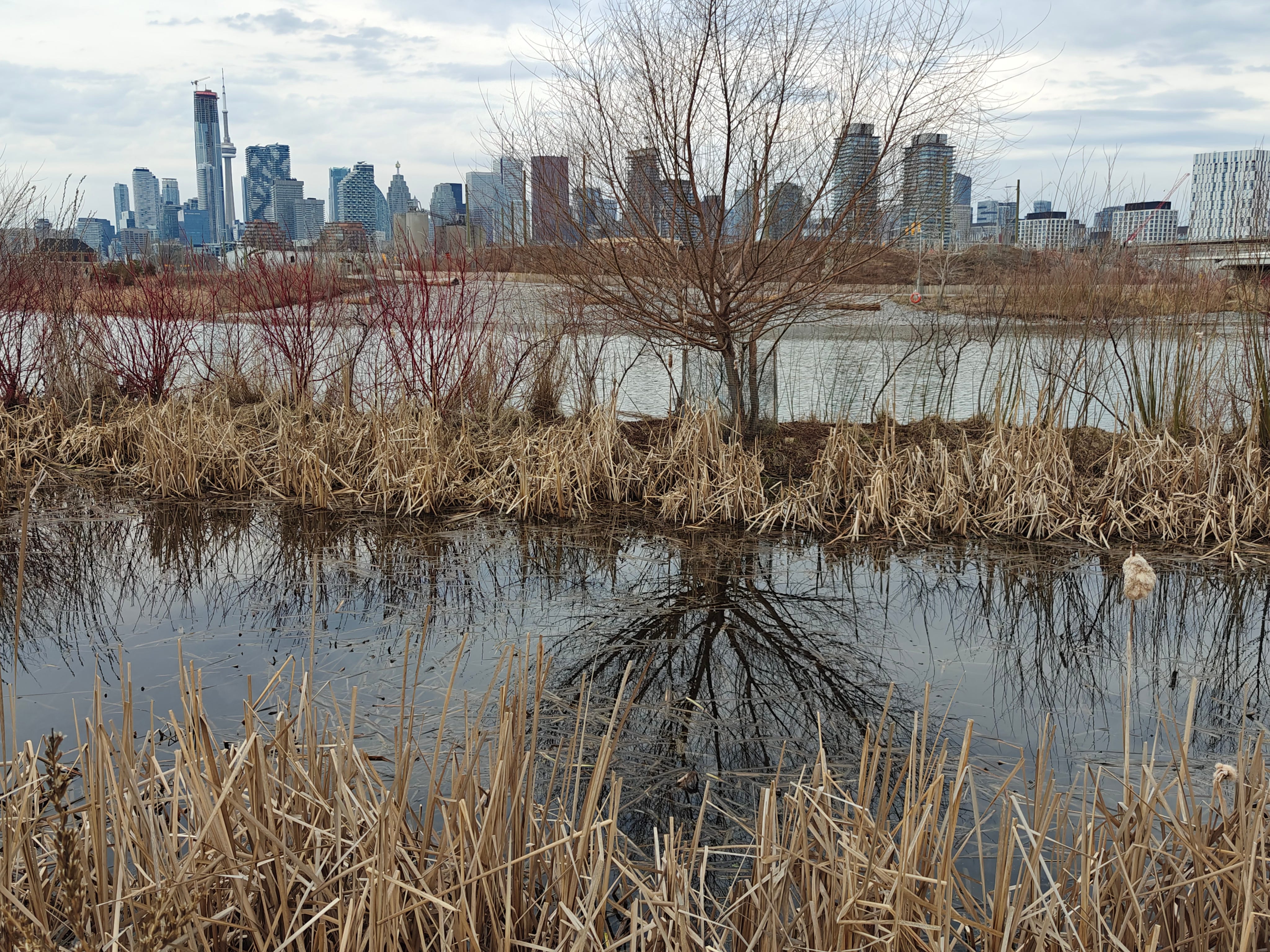
the mouth of the Don River, downtown Toronto beyond
I remember feeling numb when my father died. I was eighteen, in first year university at Queen’s in Kingston, Ontario. He was forty-eight and died of a heart attack in London. His company paid for my brother Peter and me to fly to London to join my mother. There was a funeral and a cremation. It was all unreal, like something seen on a stage or through a plate glass window. And around it was the stage set of London in the late 1960’s, with the hip fashions of King’s Road a short block from my parents’ apartment.
I was tempted to stay away, to not return to my small first-year life of classes, friends, details. Two weeks earlier, during the Christmas holidays with family friends, someone had talked lovingly about Majorca. Now in London, I imagined taking off to Majorca to see the almond trees in bloom, and from there?...whatever. It was a seductive idea.
But my practical self realised that I needed to be grounded. I was afraid that if I went traveling I’d be lost after the first momentum of departure. Looking back now, I’m grateful for my caution, though sometimes I imagine the paths my alternative life might have taken.
I flew to Canada and went back to class. Professors, unasked, excused me from assignments. I probably didn’t thank them. I just lurched through the rest of my year. And I don’t think I ever properly reflected on the loss of my father. I was so aware of my mother’s determination to not fall apart that I didn’t stop to look at what his loss meant to me and for me.
My brother and I didn’t really talk about it either. Perhaps we felt that talking about it would make it unbearable. We didn’t have the tools. (And in those days no-one rushed in with suggestions about therapy.) It’s as if keeping our grief and loss in a cupboard, as a truth we knew but couldn’t handle, was the only way we could hold ourselves together.
My brother was two years younger and a much freer person than I was. I tended to be the more compliant literal-minded older child. He was rather like Tashi in many ways, physically co-ordinated and at ease in the world, with a natural unselfconscious charm. That year, with our parents away in London, he’d been boarding at the house of family friends and finishing his last year of high school. He flew back on his own from London a few days after our father’s funeral while I stayed on a little longer. I never imagined until later how alone he must have felt flying back and returning to high school, fatherless at the age of 16. Now I weep for him too.
I next saw him and my mother in late March, when we had a service to bury my father’s ashes at Beechwood Cemetery in Ottawa. It all seemed unreal, that the three of us were together but my father was gone, ashes to pour into the ground in the springtime.
Four years later, almost to the day, my brother died in a sailing accident in the Strait of Juan de Fuca, off Vancouver Island. He was twenty.
I got a phone call on a Friday evening from Dunnery, the friend he’d been with. He was calling from the Canadian consulate in Port Angeles in Washington state. He and Peter had bought a sailboat at a police auction; it had been used for drug smuggling and needed repairs. They’d been working on it and decided to take it out for a sail. But the boat popped a leak, or the keel detached or something. I don’t remember. When the boat started sinking they’d tied some balsa wood together to keep themselves afloat in the water. The water was very cold. By the time they were picked up they’d drifted into American waters; my brother was dead and Dunnery unconscious.
I drove out to my mother’s place to tell her. I put my arms around her, pulled her onto her bed, and held her tightly as I told her. It was so unimaginable. No warning, nothing but the brutal fact of Pete being dead and gone.
I flew out to Vancouver and traveled on to my uncle’s place on Vancouver Island; my mother decided not to come. Pete’s body was shipped from Port Angeles to a funeral home there. I went with my uncle to the funeral home to make arrangements. I remember deciding not to go into the next room to see his dead body because I didn’t want that to be my last image of him.
There was a service a couple of days later at the little Anglican church in Comox, down the street from my grandmother’s small house. Pete had spent time there, loved our Grandmum (who was then 84) and our uncle and cousins very much, and they him. It was awful, a terrible time for us all.
Why am I thinking about this now and writing about it? What is going on? I have told the story of my brother’s death rarely, telling Dom and Tashi about it, for example, and a few friends. But now I’m feeling it. It’s part of the stream of deep feeling that’s taken hold of me. Each loss has become part of the next one. At last I am engaging with past losses, it seems, looking them in the eye with more capacity and understanding than I had at the time.
It’s possible to drown in loss. Perhaps survival, especially when I was young and had less understanding, required me to just keep moving, maintain some momentum, rather than risking being crushed by the weight of it all.
As I ride these waves of emotion, I find myself consoled by familiar patterns, from my live Zoom yoga class each weekday morning, to a weekly long conversational walk with friends, to Saturday trips to Wychwood Farmers’ Market and frequent walks to Kensington Market for food, to a pattern of various friends coming by for supper here and there each week. These are the things that help me put one foot in front of the other, both literally and metaphorically. I am very grateful for all of it.
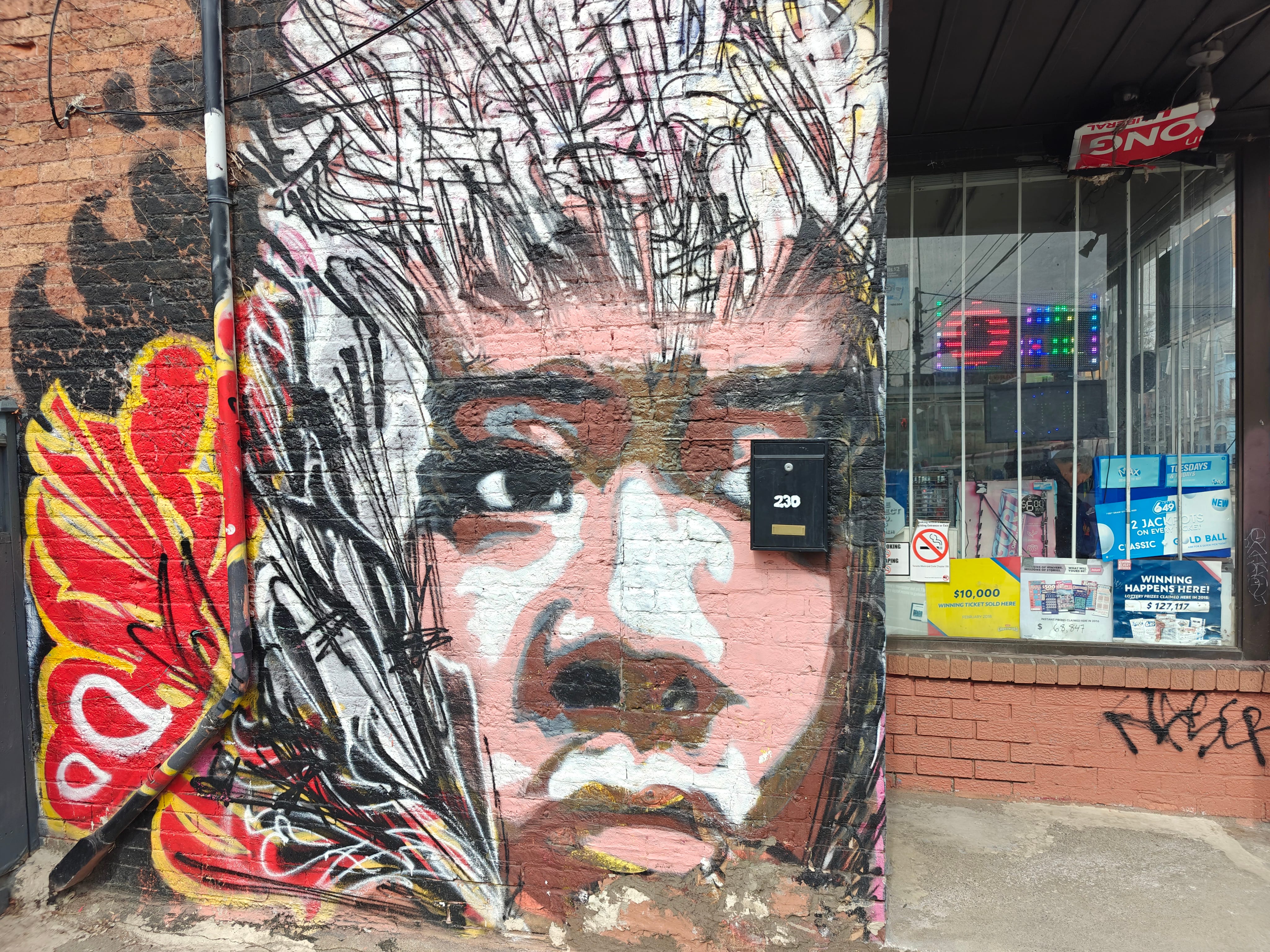
street art off Spadina Avenue in Toronto
KITCHEN EXPLORATIONS including blackcurrant syrup & leftovers-optimism
And speaking of patterns, I still depend on leftovers topped by one or two fried eggs for my (mid-)morning sustenance. Leftovers are usually rice or potato with perhaps some cooked vegetables and/or pickles or a condiment of some kind. With that I generally have a large mug of hot lemon with ginger, turmeric, and black pepper.
Recently, as I sorted through my jars of jam in the basement I came on the last of the large bottles of blackcurrant syrup that I put by a couple of years ago. It’s from a recipe for creme de cassis in Jane Grigon’s marvelous Fruit cookbook. You soak the black currants with red wine, then process them, then squeeze the juice from the pulp, add sugar and simmer the liquid down until it thickens noticeably. The recipe calls for the addition of alcohol at this point. But when I gave my good friend Dina a taste of the syrup her reaction was immediate: this is too delicious to mess up with alcohol! I left it as a syrup. Lately I’ve been treating myself to hot blackcurrant drink with a wedge of lemon rather than my usual hot lemon drink. Highly recommended.
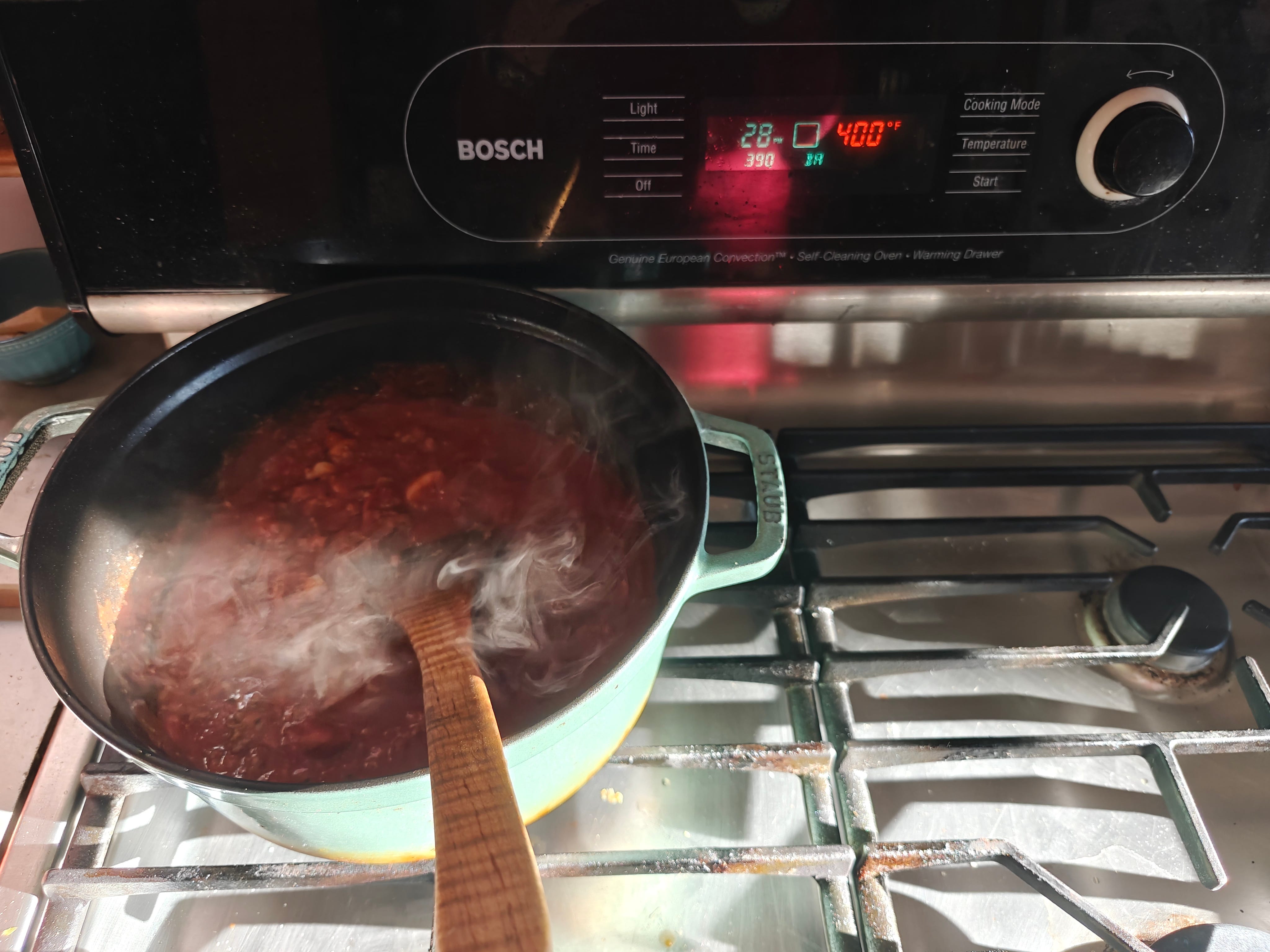
In the evening my patterns vary. This week I made a meat sauce for pasta (whole wheat fusilli). I started with mustard seeds, nigella, and cumin seeds in hot olive oil, then about 5 crushed garlic cloves and two red bird chiles, and finally a pound of Andreas’s ground lamb from Wychwood Market. I stirred it in, breaking up clumps, and soon it had all changed colour. I added most of a bottle of passata plus a chopped up large out-of-season tomato that I’d bought days earlier in a fit of bad judgement. The pot simmered gently for a good while to a lush texture, seasoned with a splash of fish sauce and some salt (I usually work with 1 teaspoon salt per pound of meat, then adjust the seasoning to taste once the sauce has cooked awhile).
.
For supper a few days later I made fried rice with leftover brown jasmine. I started with oil poured into the hot wok and tossed in some green Thai curry paste (store-bought). Once I had mixed it well into the oil, I lowered the heat and added several crushed cloves of garlic and nearly a cup of finely slivered raw cabbage. It took 4 or 5 minutes of stirring and cooking for both the garlic and cabbage shreds to soften. I raised the heat and tossed in the leftover rice. I stir-fried it briefly to break it up, added a few dashes of fish sauce, then stir-fried it a little more., pressing it against the hot sides of the wok. In went a large double handful of freshly washed and coarsely chopped spinach (also from the farmers’ market). After a couple of minutes of stir-frying the spinach had cooked to a bright wilted green. I turned the mass of rice out into a shallow bowl, squeezed on lime juice generously, sprinkled on some chopped coriander leaves, and it was ready. The leftover reheated tomato sauce was a surprisingly good side accompaniment to the rice.
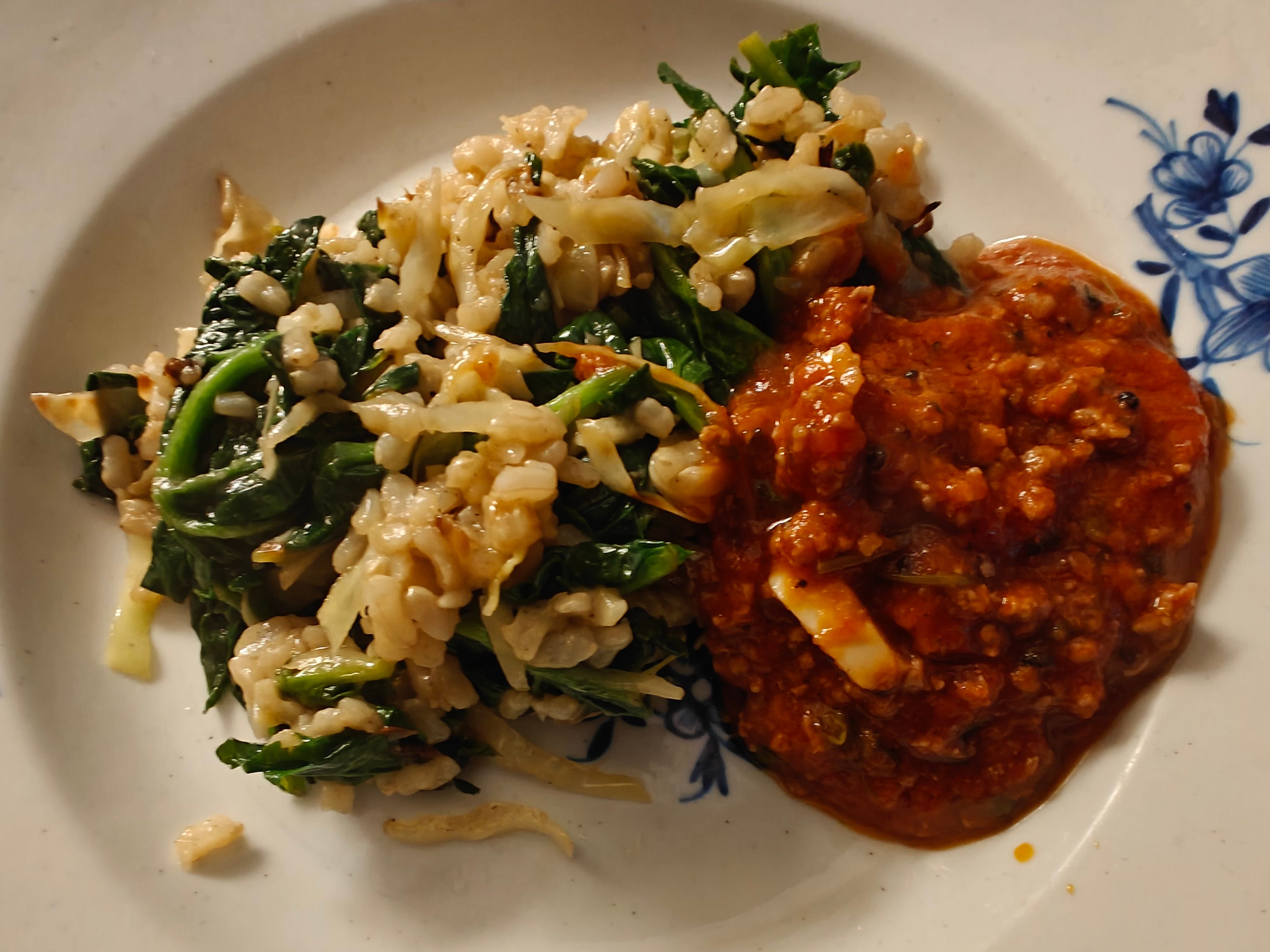
Working with leftovers is a wonderful reminder of the transformative power of cooking and imagination. It takes a little optimism, of course, but so does most cooking. And in that optimism and the food it transforms, I find new energy for the coming days
.
❤️
Naomi, my heart weeps for your sorrow. I’m reminded of a quote from Francis Weller: “Grief and love are sisters, woven together from the beginning. Their kinship reminds us that there is no love that does not contain loss and no loss that is not a reminder of the love we carry for what we once held close.” It’s from his book, The Wild Edge of Sorrow, which gave me great comfort when I lost my sister.
Wishing you peace as spring wraps her warm arms around us 💕