
As we head towards Wednesday’s full moon, my head is loaded with to-do lists, with thoughts of ripe fruit of all kinds, and with all that I learned at an online fermentation conference. But first some thoughts about connection.
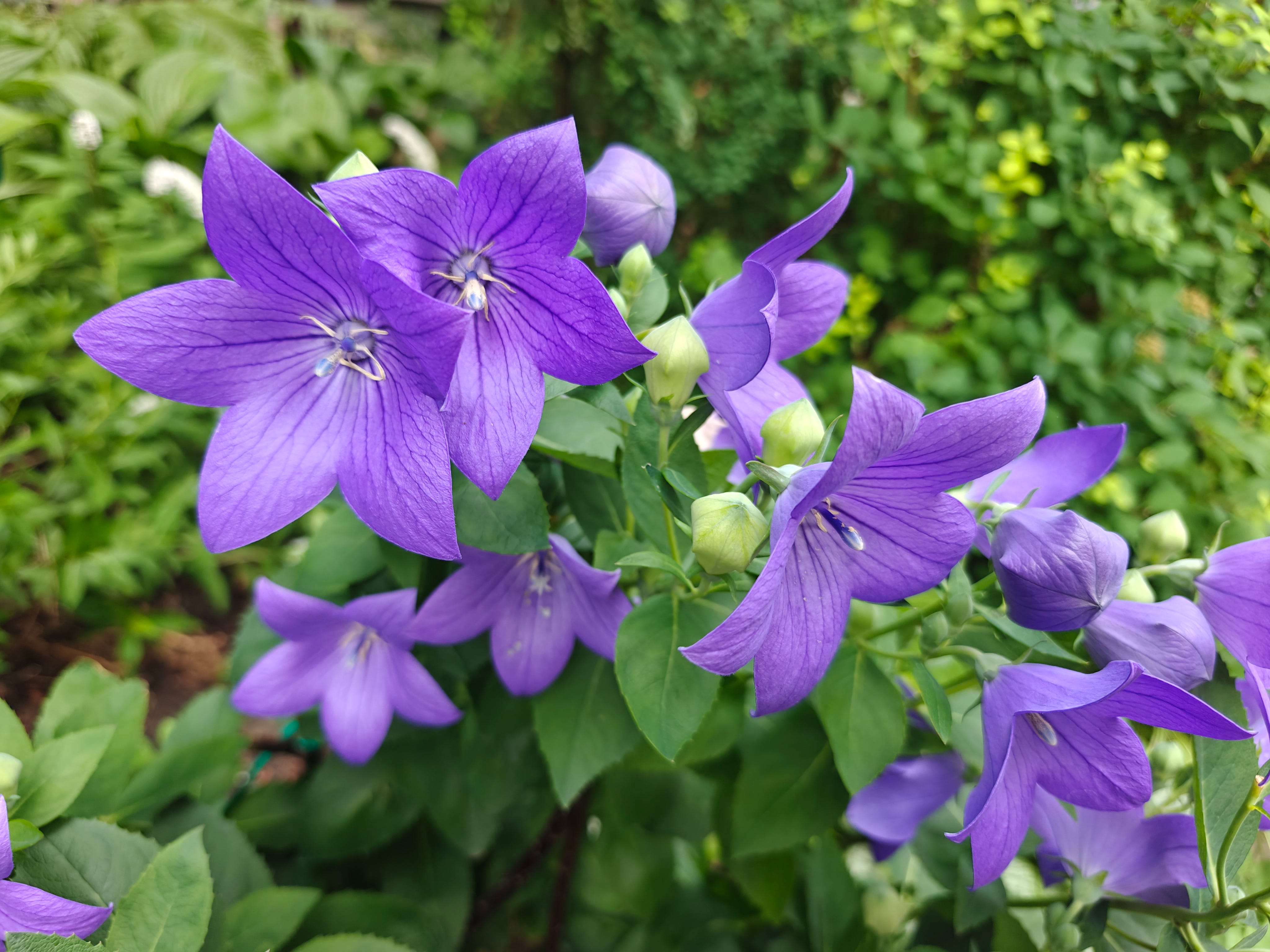
bellflowers in a garden near Wychwood farmer’s market
One day recently a neighbour whom I hadn’t seen in a long while came by unexpectedly, bringing me a huge brown paper bag full of garlic scapes from her country garden. She was not at ease when I came out to greet her. I realised that she was very stressed and that coming by had taken great determination. She had not been in touch when Tashi died last November. Her son had been around, lovely man, but somehow the pressure and the awfulness of our loss had kept her away. I knew she felt terrible about Tashi’s death and I could see that she was burdened by all of it. She handed me the bag of garlic scapes and we chatted for a few minutes in a fragile way. We hugged, and I thanked her, then she turned and walked back home.
Later, as I trimmed and chopped the scapes, then processed them with olive oil and a little salt, I kept thinking about her and the many other people who get stuck worrying about what to say or how to be with other people’s loss. There’s no “right answer” of course. We can’t be sure that expressions of sympathy will land well. But the human connection that happens when we take the chance to embrace someone else’s sorrow is important. It’s life-giving. We need to try to move forward into it, in whatever way we are able. In this case my neighbour’s courage, and the garlic scapes, gave her a path across her intense anxiety into connection.
Speaking of connection, this week I saw a large show of artist David Blackwood’s etchings, full of feeling, history, and stunning Newfoundland scenes and stories. The sense of the past living on in the present is very strong in his work. And it’s beautiful.
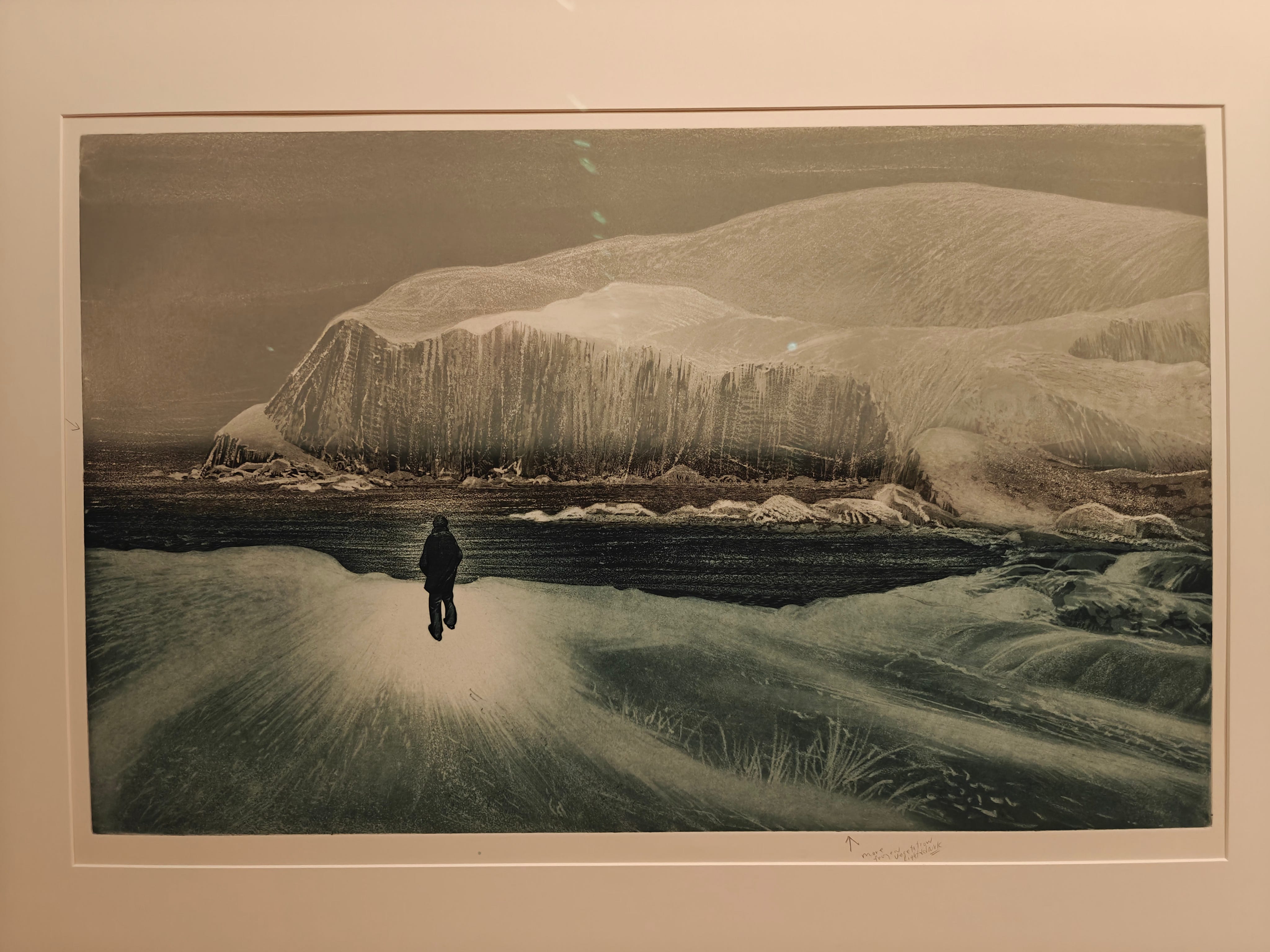
a David Blackwood print from 1975
In a very different way, the work of Korean conceptual artist Kimsooja, is intensely moving. Her show at MOCA (on for a few more weeks) is called Dimensions of a Needle. Large cloth bundles (bottari in Korean) are set on the floor next to linen screens woven from hemp she grew, or under hanging lengths of found fabric. The work is about relationship rather than making new. There was a calm rightness to it all.

Kimsooja’s work at MOCA
KITCHEN EXPLORATIONS, with talk of improvisation, black currant syrup, black currant jam, garlic scape “pesto” and more
This week I bought some of the first zucchinis of the season, sliced them lengthwise, and brushed on a little fish sauce and olive oil. The slices grilled over charcoal, along with two fresh onions. Chopped up, and combined with about eight to ten anchovies chopped small, and coarsely grated parmigiano Reggiano, as well as a little olive oil, the zucchini and onion made a wonderful dressing for beautiful loops of pappardelle. I love the flexibility and flavour that anchovies give when I’m making vegetable-forward meals.


grilled zucchini & onion; dressed pappardelle with a side of broccolini
You may have advice for me about garlic scapes. I know some people process them with oil and then freeze the mash in small batches. That seems like a good plan for those who are organised and keep track of what’s in their freezer. I am better if I can see the things I have stored, so instead of freezing the processed scapes I jammed the green mass into several glass jars and put those in the fridge. Yes, my fridge tends to be over-full. But usually I do see what’s there, sooner or later, which then reminds me to use what I’ve stored. Also, those jars are so bright green and hopeful looking. They’ll be a pleasure in the dark days of January, if we don’t eat them all in November-December. You can toss spoonfuls of their fresh greenness into soup; use the paste to make a pesto with pine nuts or other nuts; toss it into beans/dal or stews for a hit of fresh garlic life...
This is the season of plenty, with pressure to preserve and put by all the produce that overflows the farmers’ market and our gardens.
Last weekend I found myself with a surfeit of black currants, a nice problem to have. My bush has been picked over, but the season has just started north of Toronto. I learned a week ago that Jens and Ayse of Marvellous Edibles would have black currants at the Brickworks Farmers Market. I wrote to ask if I could order 2 to 3 pounds of them, because a friend had said he could go and pick them up for me. It all worked well, except that Ayse’s guess about quantity ended up being very generous, which is how I found myself with 2500 grams/5 pounds of black currants to process, twice as much as I had expected.
I had planned to make cassis syrup, the base of crème de cassis, the recipe for which is in Jane Grigson’s wonderful Fruit book. With this much fruit, I needed to make a double recipe. I still had fruit left over for a little jam. (Black currants are so full of pectin that even with much less sugar than most recipes call for the jam tends to set well.) The syrup recipe calls for soaking a kilo of fruit in a litre of red wine for a good 48 hours. Then the mixture gets processed to a mash (I did it in batches in my food processor) before being placed in a large bowl lined with “old sheeting” advises Jane Grigson. I used a large tea towel. It’s a strenuous process, wringing the fruit juice out of the fruit. I did it in two batches. By the time I had wrung out all the juice my hands were tired and they looked like a Lady Macbeth-themed bloodbath. (The tea towel I used is permanently dyed a kind of dull purple-grey.)


black currants soaking; detail of pressing the mashed soaked black currants
The next step is to pour the juice into a wide pan, add a measured amount of sugar, and cook gently, at less than a simmer, for a good two to three hours, stirring it occasionally, until it thickens a little. I lost track at one point and let it come to a low boil, a no-no. The result was that I had a frothy scum rise to the surface. I kept skimming it off, hoping I hadn’t wrecked the syrup. The froth became a half-cup of not-quite jam, delicious. And the syrup did eventually thicken and is now in labelled bottles, three one-litre bottles and several smaller jars. Whew.
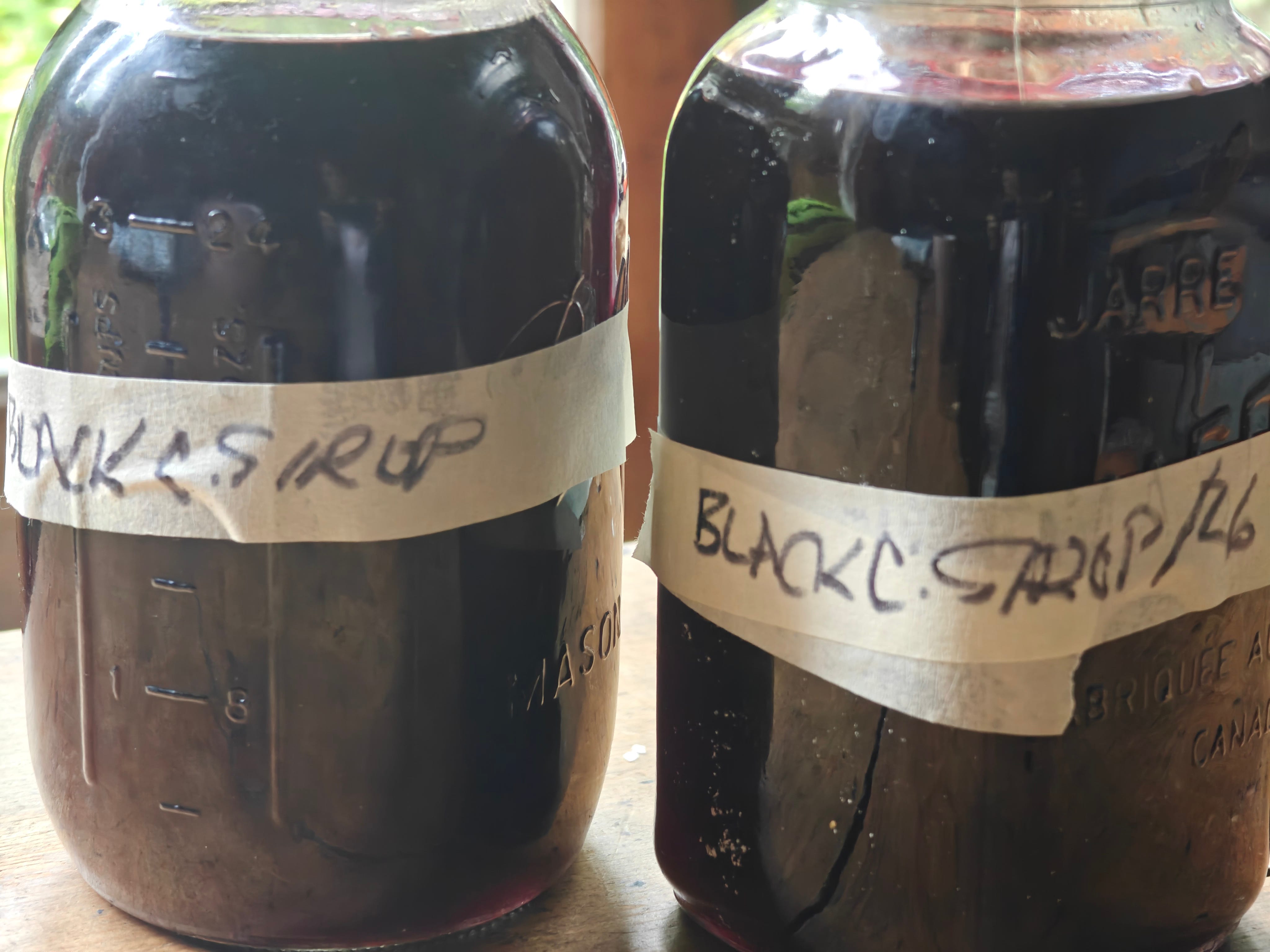
The result of all this effort will remind me of summer in the winter months, and of the wisdom of our fore-mothers who showed us the way.
As I write this I’m sitting in my small back garden with the trickling sound of the fountain keeping me company. The fountain has had its troubles recently: it sprang a leak, which we were unable to patch successfully. What to do? I needed a waterproof container. A friend suggested that I look for a stock tank, a category of thing I hadn’t heard of: containers used for watering (farm) animals. They come in many sizes. (I’m told that they’ve now become go-to items for many city people. They’re being used as cold water plunge pools or children’s wading pools, for example.)
I had imagined figuring how to use our small pump to make a fountain-ish flow somehow in a new container. Instead, for now our solution is to set the old fountain in the new basin. The arrangement is somewhat inelegant but at least it gives us the sound of running water. The old leaky wall-side fountain is resting atop some pieces of wood placed on the bottom of the tank. Tank and old fountain are both full of water to the same level, so it all works. I’m grateful.
Imperfection is a fact of life that I am happy to accept. Rather than buying new or making perfect, I prefer to make do and improvise. I hate throwing things out. “Is there not some way to make this work?” is kind of an underlying question to me, in many contexts.


improvised grilled eggplant, mashed and dressed with a little pomegranate molasses, plus fresh tarragon; then served with local corn, green beans, and lake trout
Perhaps that’s why I like improvising when I cook. It’s a kind of ongoing creative problem-solving that usually feels interesting, and of course occasionally becomes a bit fraught and exciting.
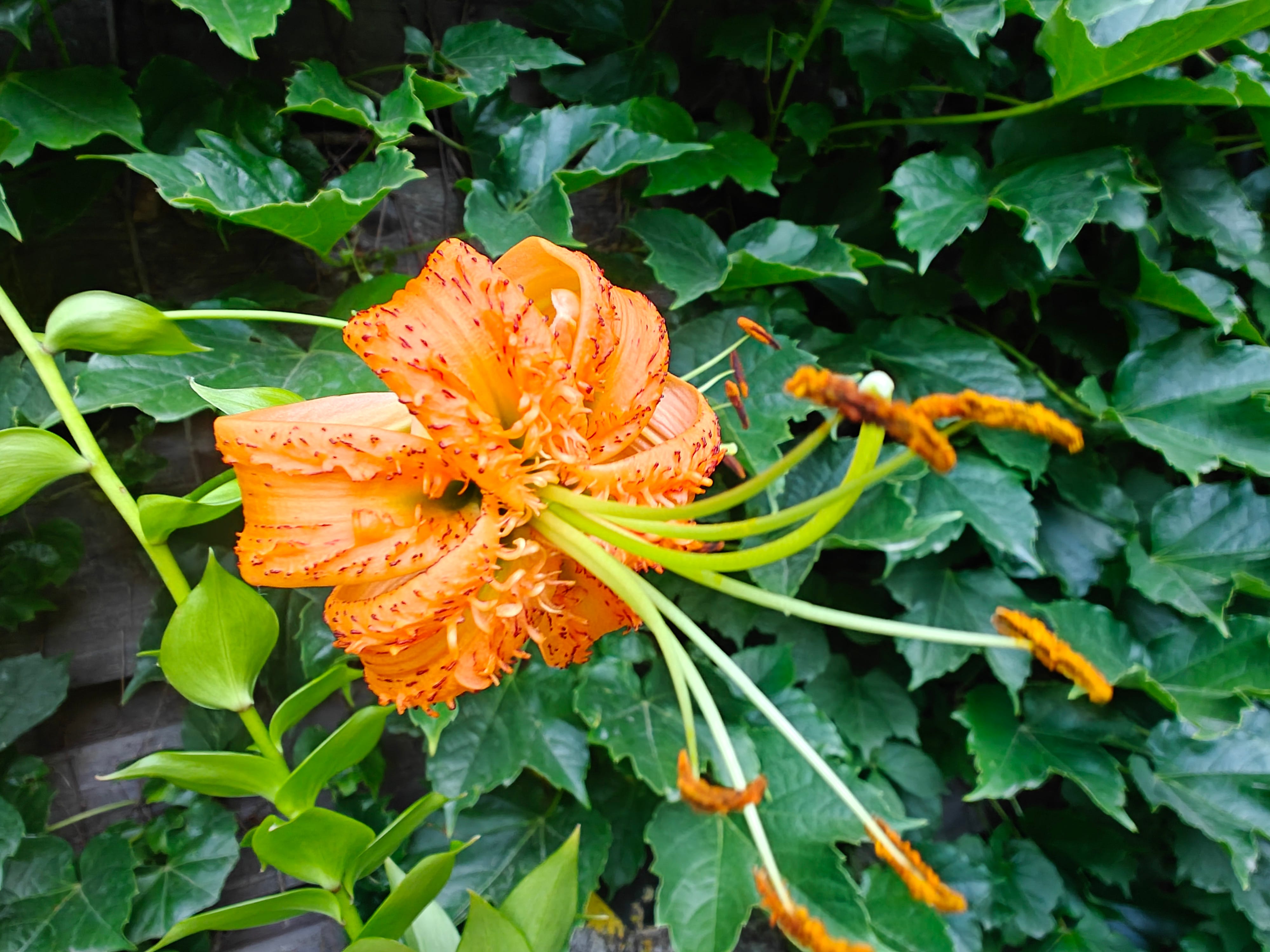
mother nature is amazing
RESOURCES - FERMENTATION
Last week, Monday to Friday, I attended the Desi Cultures conference, three hours a day on Zoom, all about fermentation, from history to politics, with a focus on the mountain regions of India. It was fascinating and very generous, with the bonus that the recordings of the speakers (two per day) and ensuing discussions are stored online, together with links to related materials. What a treasure trove that Desi cultures library is. And it will only get richer.
I don’t know how people who didn’t register for the conference can get access. Perhaps it will be possible to become a member, or to buy a reader’s ticket to the library. Check with Desi Cultures on Instagram to inquire. Highly recommended altogether, both speakers and discussions. I especially loved hearing presentations by many people whose excellent work I hadn’t known about, including Professor Dolly Kikon, Vasun Ramasamy, Dr Kurush Dalal, and Dr Hissay Lepcha.
Naomi, you've yet again put into words so much of what I feel about gardening and cooking and life: it's all about the jugaad, the improvising and the creative problem-solving. The fun is precisely when it becomes a bit fraught and exciting! And yet this can be so hard for folks who don't spend a lot of time in the kitchen -- or garden, or outside certain confines-- to understand. (I love the work of Kimsooja, and wonder how those panels of cloth might have looked stained with the blackcurrants!)